 Back
Water, pH, Functional Groups, and Biomolecules: Foundations of Biological Chemistry
Study Guide - Smart Notes
 Tailored notes based on your materials, expanded with key definitions, examples, and context.
pH, Acids, Bases, and Buffers
Water Ionization and pH
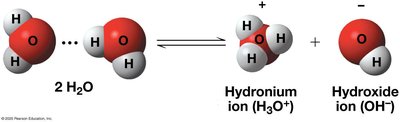
Water is a critical molecule in biology, capable of ionizing to form hydronium and hydroxide ions. The concentration of hydrogen ions (H+) in solution determines the pH, which in turn affects the structure and function of biomolecules.
Ionization of Water: Two water molecules interact to form hydronium (H3O+) and hydroxide (OH-) ions.
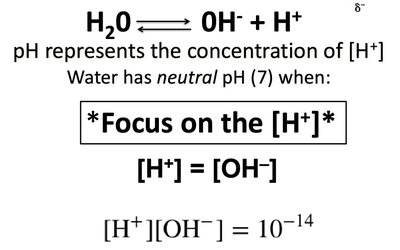
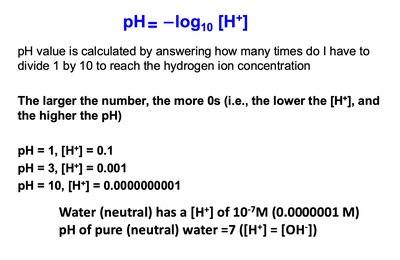
pH Definition: pH is the negative logarithm (base 10) of the hydrogen ion concentration:
Neutral pH: In pure water, [H+] = [OH-] = M, so pH = 7.
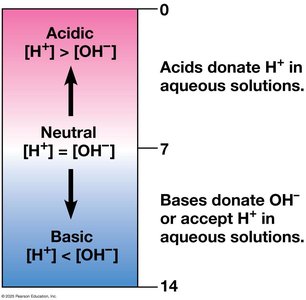
pH Scale: Ranges from 0 (most acidic) to 14 (most basic). Each unit change represents a tenfold change in [H+].
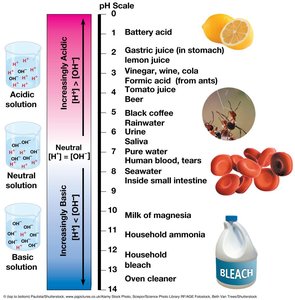
Understanding the Logarithmic pH Scale
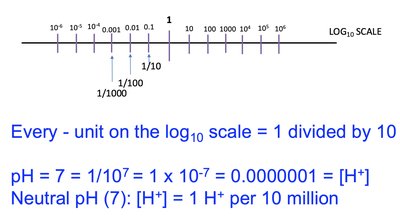
The pH scale is logarithmic, meaning each step represents a tenfold difference in hydrogen ion concentration. This allows for a wide range of acidity and basicity to be represented in a compact scale.
Formula:
Examples: If [H+] = 0.001 M, then pH = 3. If [H+] = 0.0001 M, then pH = 4.
Comparison: A solution with pH 3 has 1000 times more H+ than a solution with pH 6.
Acids, Bases, and Buffers
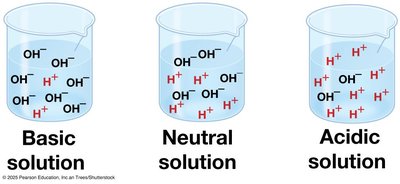
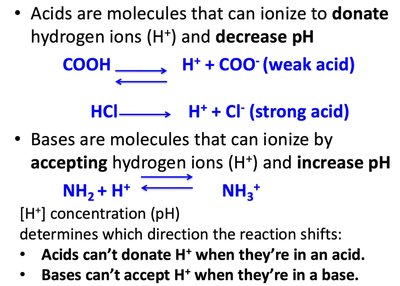
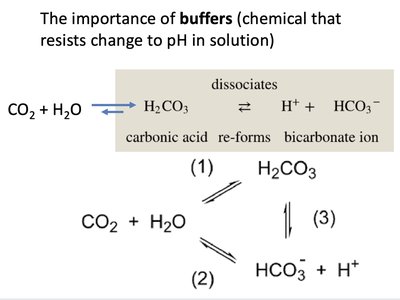
Acids are substances that donate H+ ions, while bases accept H+ or donate OH-. Buffers are chemicals that resist changes in pH, maintaining homeostasis in biological systems.
Acids: Increase [H+] and lower pH (e.g., HCl, COOH).
Bases: Decrease [H+] by accepting H+ or releasing OH- (e.g., NH2).
Buffers: Mixtures that minimize pH changes by reversible binding or release of H+ (e.g., bicarbonate buffer system in blood).
Functional Groups and Molecular Diversity
Carbon: The Backbone of Life
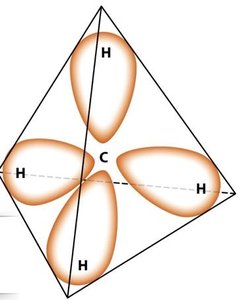
Carbon atoms can form four covalent bonds, allowing for a variety of molecular shapes and the formation of large, complex molecules. This versatility is the foundation of organic chemistry and biological diversity.
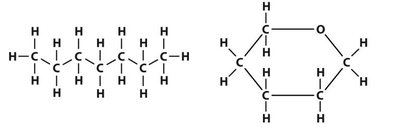
Bonding: Carbon can bond to four other atoms, forming chains, branches, or rings.
Organic Compounds: Molecules containing carbon-carbon (C-C) bonds are called organic compounds.
Functional Groups
Functional groups are specific groups of atoms attached to the carbon skeleton that determine the chemical properties and reactivity of organic molecules. Only a few functional groups are common in biological molecules, but they provide great diversity.
Examples: Hydroxyl (-OH), Carboxyl (-COOH), Amino (-NH2), Phosphate (-PO4), Carbonyl (C=O).
Role: Functional groups participate in chemical reactions and influence molecular behavior (e.g., acidity, polarity).
Making and Breaking Biomolecules
Macromolecules and Polymers
Cells synthesize large molecules (macromolecules) from smaller building blocks (monomers). Most biological macromolecules are polymers, made by linking monomers in a chain.
Four Major Classes: Carbohydrates, Proteins, Nucleic Acids, Lipids.
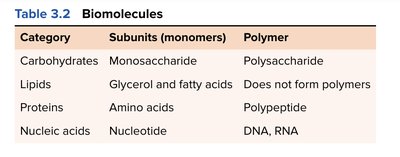
Monomers and Polymers: Monosaccharides form polysaccharides, amino acids form polypeptides, nucleotides form nucleic acids, and fatty acids/glycerol form lipids (not true polymers).
Category | Subunits (Monomers) | Polymer |
|---|---|---|
Carbohydrates | Monosaccharide | Polysaccharide |
Lipids | Glycerol and fatty acids | Does not form polymers |
Proteins | Amino acids | Polypeptide |
Nucleic acids | Nucleotide | DNA, RNA |
Dehydration Synthesis and Hydrolysis
Polymers are assembled and disassembled by two main types of reactions:
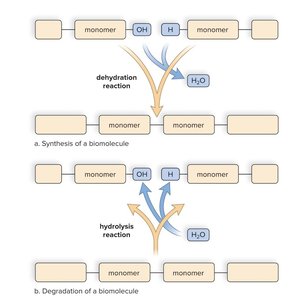
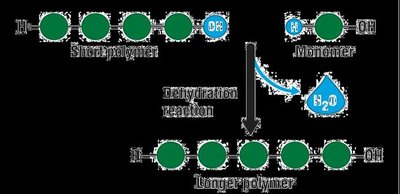
Dehydration Synthesis (Condensation): Monomers are joined by covalent bonds, releasing a molecule of water.
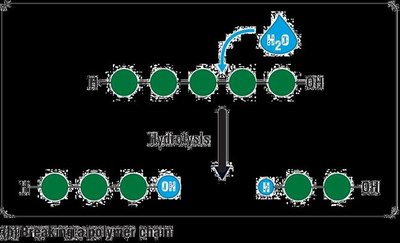
Hydrolysis: Polymers are broken down into monomers by the addition of water, breaking covalent bonds.
Enzymes: Specialized proteins that catalyze both dehydration and hydrolysis reactions, increasing reaction rates.
Proteins and Enzymes
Proteins: Structure and Function
Proteins are polymers of amino acids and are the most abundant macromolecules in cells. Their structure determines their function, which includes catalysis, transport, defense, and more.
Amino Acids: The monomers of proteins, each with a central carbon, amino group, carboxyl group, hydrogen, and variable side chain (R group).
Peptide Bonds: Covalent bonds linking amino acids in a polypeptide chain, formed by dehydration synthesis.
Levels of Structure:
Primary: Sequence of amino acids.
Secondary: Local folding (alpha helices, beta sheets) via hydrogen bonds.
Tertiary: Overall 3D shape due to side chain interactions.
Quaternary: Association of multiple polypeptide subunits (if present).
Denaturation: Loss of protein structure (and function) due to changes in pH, temperature, or chemicals. Primary structure remains intact.
Enzymes: Biological Catalysts
Enzymes are proteins that accelerate chemical reactions by lowering activation energy. They are highly specific for their substrates and are not consumed in the reaction.
Active Site: The region on the enzyme where the substrate binds and the reaction occurs (lock-and-key model).
Mechanism: Enzymes orient substrates, strain bonds, and provide a favorable microenvironment for the reaction.
Enzyme-Substrate Complex: Temporary association between enzyme and substrate during catalysis.
Enzyme Regulation: Enzyme activity can be regulated by substrate concentration, inhibitors, and activators.
Types of Enzyme Inhibitors
Competitive Inhibitors: Resemble the substrate and compete for binding at the active site.
Non-competitive (Allosteric) Inhibitors: Bind elsewhere on the enzyme, changing its shape and reducing activity.
Enzyme Activators
Phosphorylation: Addition of phosphate groups (by kinases) can activate or deactivate enzymes.
Dephosphorylation: Removal of phosphate groups (by phosphatases) can reverse the effect.
Example: Catalase is an enzyme that breaks down hydrogen peroxide (H2O2) into water and oxygen, protecting cells from oxidative damage.
Additional info: Enzyme kinetics (reaction rates) are influenced by substrate concentration, enzyme concentration, temperature, pH, and the presence of inhibitors or activators.
----------------------------------------
