 Back
Chapter 3: Water - Properties and Importance in Biology
Study Guide - Smart Notes
 Tailored notes based on your materials, expanded with key definitions, examples, and context.
Water: An Indispensable Molecule for Life
Overview of Water's Biological Significance
Water is essential for all known forms of life, playing critical roles in cellular structure, metabolism, and environmental stability. Its unique chemical and physical properties make it a fundamental molecule in biological systems.
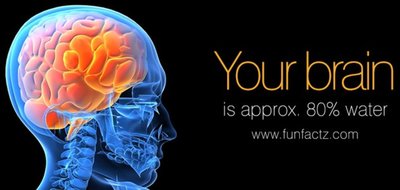
Water composition: Most organisms are composed largely of water, which facilitates biochemical reactions and transport of substances.
Memory and cognition: Adequate hydration is linked to improved memory and cognitive function in humans.
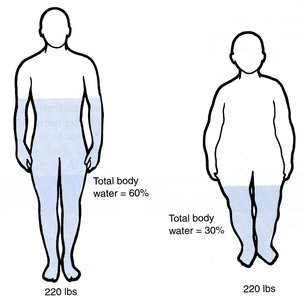
Distribution in the body: Water content varies with body composition, affecting physiological processes.
Four Crucial Properties of Water
Cohesive Behavior
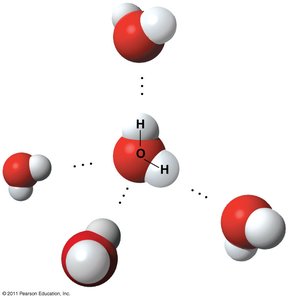
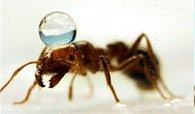
Cohesion refers to the attraction between water molecules due to hydrogen bonding. This property is responsible for surface tension and enables water to move through plant tissues.
Hydrogen bonding: Water molecules form hydrogen bonds, creating a network that holds them together.
Surface tension: The cohesive forces at the surface of water allow small organisms to walk on water and enable droplets to form.
Transport in plants: Cohesion assists in the movement of water from roots to leaves via capillary action.
Temperature Moderation
Water moderates temperature through its high specific heat, which is the amount of heat required to change its temperature by one degree Celsius. This property helps organisms resist rapid temperature changes.
High specific heat: Water absorbs and releases heat slowly, stabilizing environmental and internal temperatures.
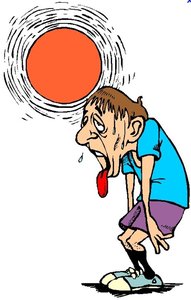
Evaporative cooling: When water evaporates, it removes heat, cooling surfaces such as skin.
Expansion Upon Freezing
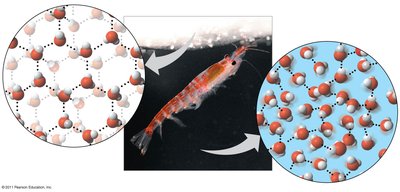
Water expands as it freezes, making ice less dense than liquid water. This property is crucial for aquatic life and environmental stability.
Hydrogen bonds in ice: In solid form, water molecules are held in a stable lattice, increasing volume and decreasing density.
Ecological impact: Ice floats, insulating aquatic environments and protecting organisms below.
Solvent Properties
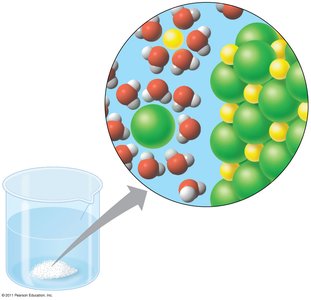
Water's polarity allows it to dissolve a wide range of substances, making it an excellent solvent for biological reactions.
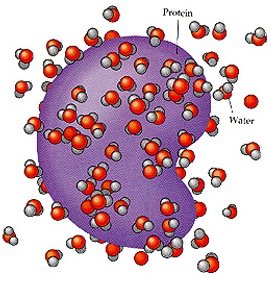
Hydration shells: Water molecules surround ions and polar molecules, facilitating their dissolution.
Hydrophilic vs. hydrophobic: Hydrophilic substances dissolve easily in water, while hydrophobic substances do not.
Aqueous Solutions and Molarity
Preparation and Properties of Solutions
Aqueous solutions are mixtures where water is the solvent. The concentration of solutes is measured in molarity (M), which is moles of solute per liter of solution.
Molecular weight: The sum of atomic masses in a molecule, expressed in Daltons.
Mole: A unit representing the quantity of a substance equal to its molecular weight in grams.
Molarity:
Example: To make a 1M solution of NaCl, dissolve 58.45 g NaCl in 1L water.
Acid/Base Chemistry and pH
Acids, Bases, and Buffers
The acidity of a solution is determined by the concentration of hydrogen ions ([H+]), measured on the pH scale.
Acid: Increases [H+] in solution.
Base: Decreases [H+] in solution.
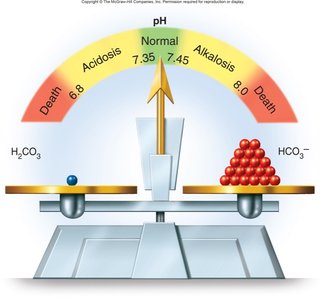
Buffer: Resists changes in pH by absorbing or releasing H+ ions.
pH calculation:
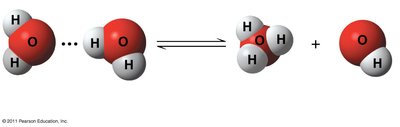
Water dissociation:
At 25°C:
pH Scale and Biological Relevance
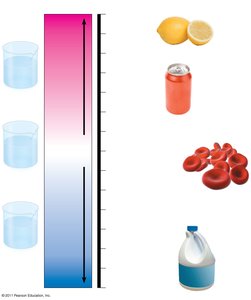
The pH scale ranges from 0 (most acidic) to 14 (most basic), with 7 being neutral. Biological systems require tightly regulated pH for proper function.
Examples: Human blood has a pH of about 7.4; gastric juice is highly acidic.
Logarithmic scale: Each unit change represents a tenfold difference in [H+].
Substance | Approximate pH |
|---|---|
Battery acid | 0 |
Gastric juice | 1-2 |
Pure water | 7 |
Human blood | 7.4 |
Household bleach | 12-13 |
Summary Table: Four Properties of Water
Property | Description | Biological Importance |
|---|---|---|
Cohesion | Hydrogen bonding between water molecules | Surface tension, transport in plants |
Temperature Moderation | High specific heat | Stabilizes organism and environmental temperatures |
Expansion Upon Freezing | Lower density of ice | Ice floats, insulates aquatic life |
Solvent Properties | Polarity and hydration shells | Dissolves ions and polar molecules |
Additional info:
Water's role in memory and cognition is supported by experimental data, as shown in memory tests after water consumption.
Hydrogen bonding is fundamental to water's unique properties, influencing its behavior in biological systems.
