 Back
Water: Properties and Importance in Biology
Study Guide - Smart Notes
 Tailored notes based on your materials, expanded with key definitions, examples, and context.
Water: The Essential Molecule for Life
Introduction to Water in Biology
Water is the most abundant molecule in living organisms and covers about three-quarters of the Earth's surface. Its unique chemical and physical properties make Earth habitable and support all known forms of life.
All living organisms require water for survival, metabolism, and homeostasis.
The abundance of water is a primary reason for Earth's habitability.
Hydrogen bonding gives water its remarkable properties.

The Structure and Polarity of Water
Molecular Structure and Hydrogen Bonding
Water (H2O) is a polar molecule, meaning it has regions of partial positive and negative charge due to the unequal sharing of electrons between oxygen and hydrogen atoms.
Polarity: Oxygen is more electronegative, giving it a partial negative charge (δ−), while hydrogens are slightly positive (δ+).
Covalent bonds hold the atoms within a water molecule together.
Hydrogen bonds form between water molecules, creating a network of interactions.
This polarity and hydrogen bonding are responsible for water's unique properties.
Emergent Properties of Water
Overview of Key Properties
Four emergent properties of water, all due to its polarity and hydrogen bonding, contribute to Earth's suitability for life:
Cohesive and adhesive behavior (including surface tension and capillary action)
Ability to moderate temperature
Expansion upon freezing
Versatility as a universal solvent
Cohesion, Adhesion, and Surface Tension
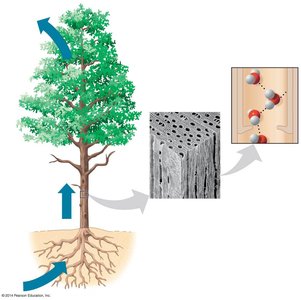
Cohesion refers to the attraction between water molecules due to hydrogen bonding, which helps transport water against gravity in plants. Adhesion is the attraction between water and other substances, contributing to capillary action.
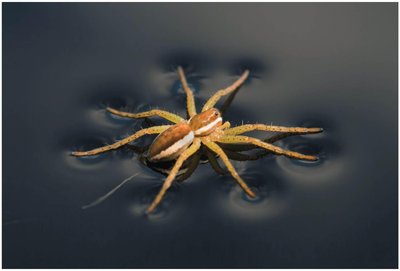
Surface tension is the measure of how difficult it is to break the surface of a liquid, resulting from cohesive forces among water molecules.
Moderation of Temperature by Water
Water moderates Earth's climate and the temperature of living organisms by absorbing and releasing heat with minimal temperature change. This is due to its high specific heat capacity.
Specific heat is the amount of heat required to raise 1 g of a substance by 1°C.
Water's specific heat is 1 cal/g/°C, much higher than most substances.
Hydrogen bonds must break to absorb heat and form to release heat, buffering temperature changes.
This property stabilizes ocean and body temperatures, supporting life.



Evaporative Cooling
Evaporation is the transformation of a substance from liquid to gas, which requires energy. Water's high heat of vaporization allows for evaporative cooling, where the surface cools as water evaporates (e.g., sweating in animals).
Heat of vaporization is the quantity of heat a liquid must absorb for 1 g to be converted to gas.
Evaporative cooling helps stabilize temperatures in organisms and aquatic environments.
Expansion Upon Freezing
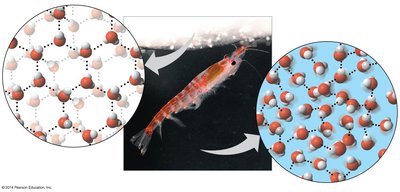
Unlike most substances, water expands as it freezes. Ice is less dense than liquid water because hydrogen bonds form a stable, ordered structure (crystal lattice) that spaces molecules farther apart.
Ice floats, insulating water below and allowing life to persist under frozen surfaces.
Water reaches its maximum density at 4°C.
Water: The Universal Solvent
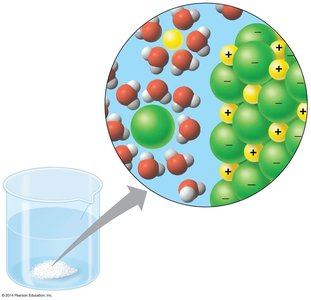
Water is called the universal solvent because its polarity allows it to dissolve a wide variety of substances, forming aqueous solutions essential for biological processes.
Solution: Homogeneous mixture of two or more substances.
Solvent: The dissolving agent (water).
Solute: The substance dissolved.
Aqueous solution: Solution where water is the solvent.
Water forms hydration shells around ions, separating and dissolving them.
Hydrophilic and Hydrophobic Substances
Substances that interact with water are classified as:
Hydrophilic: Affinity for water (polar or ionic, e.g., salts, carbohydrates).
Hydrophobic: Repel water (nonpolar, e.g., lipids).
Large polar molecules, such as proteins, can dissolve in water if they have ionic or polar regions.
Acids, Bases, and pH
Dissociation of Water and pH Scale
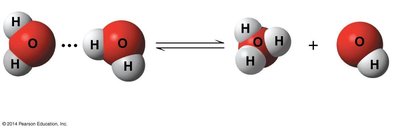
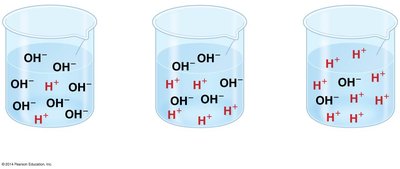
Water can dissociate into hydronium ions (H3O+) and hydroxide ions (OH−). The concentration of these ions determines the acidity or basicity (pH) of a solution.
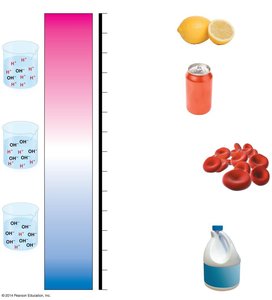
Acid: Increases H+ concentration in solution.
Base: Reduces H+ concentration (either by accepting H+ or donating OH−).
pH scale: Ranges from 0 (most acidic) to 14 (most basic); pH 7 is neutral.
Most biological fluids have pH values between 6 and 8.
The pH is calculated as:
Buffers and Biological Importance
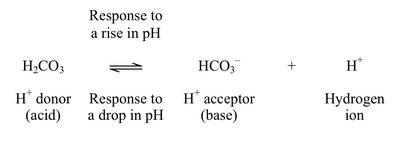
Buffers are substances that minimize changes in pH by reversibly binding H+ or OH−. Most buffers consist of a weak acid and its conjugate base.
Buffers are essential for maintaining homeostasis in living organisms.
Example: Carbonic acid-bicarbonate buffer system in human blood.
The buffer reaction:
Acidification and Environmental Impact
Ocean Acidification
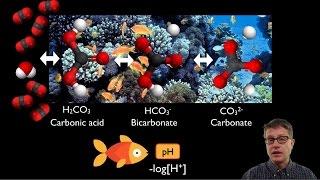
Human activities, such as burning fossil fuels, increase atmospheric CO2, which dissolves in oceans to form carbonic acid. This process, called ocean acidification, lowers ocean pH and reduces carbonate ion availability, threatening marine organisms that build shells and skeletons from calcium carbonate.
CO2 + H2O → H2CO3 (carbonic acid)
H2CO3 → HCO3− + H+
Lower carbonate ion concentrations hinder shell formation in corals, mollusks, and some plankton.
Temperature, Heat, and Solution Concentration
Temperature and Heat
Kinetic energy is the energy of motion. Thermal energy (heat) is the total kinetic energy due to molecular motion. Temperature measures the average kinetic energy of molecules.
The Celsius scale (°C) is commonly used in science.
1 calorie (cal) is the heat needed to raise 1 g of water by 1°C.
1 kilocalorie (kcal) = 1,000 cal (used in food energy).
1 joule (J) = 0.239 cal; 1 cal = 4.184 J.
Solute Concentration in Aqueous Solutions
Most biochemical reactions occur in aqueous solutions. The concentration of solutes is measured in molarity (M), which is the number of moles of solute per liter of solution.
Molecular mass: Sum of all atomic masses in a molecule.
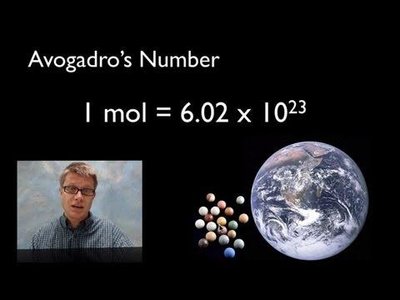
Mole (mol): 6.02 × 10²³ molecules (Avogadro’s number).
1 mole of a substance has a mass equal to its molecular mass in grams.
Summary Table: Properties of Water
Property | Description | Biological Importance |
|---|---|---|
Cohesion/Adhesion | Hydrogen bonds hold water molecules together and to other substances | Transport in plants, surface tension |
High Specific Heat | Resists temperature changes | Stabilizes climate and organism temperature |
Expansion Upon Freezing | Ice is less dense than liquid water | Insulates aquatic life in winter |
Universal Solvent | Dissolves many substances due to polarity | Facilitates chemical reactions in cells |
