 Back
Water: Properties, Solvent Function, and pH in Biological Systems
Study Guide - Smart Notes
 Tailored notes based on your materials, expanded with key definitions, examples, and context.
Water and Its Importance in Biology
Structure and Polarity of Water
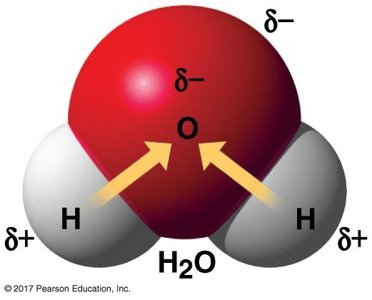
Water (H2O) is a polar molecule, meaning it has a partial positive charge on the hydrogen atoms and a partial negative charge on the oxygen atom. This polarity is crucial for many of water's unique properties and its role in biological systems.
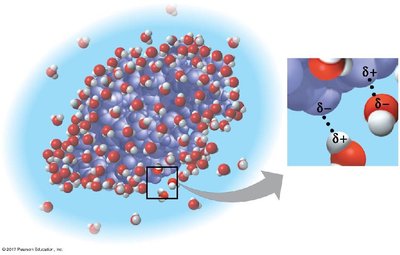
Polarity: The oxygen atom attracts electrons more strongly than hydrogen, resulting in a partial negative charge (δ-) on oxygen and partial positive charges (δ+) on hydrogen.
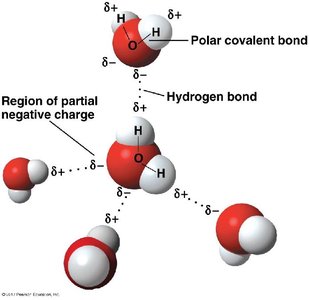
Hydrogen Bonding: Water molecules form hydrogen bonds with each other, which are responsible for many of its special properties.
Example: The polarity of water allows it to interact with other polar molecules and ions, making it an excellent solvent.
Special Properties of Water
Water exhibits several unique properties due to its molecular structure and hydrogen bonding. These properties are essential for life and biological processes.
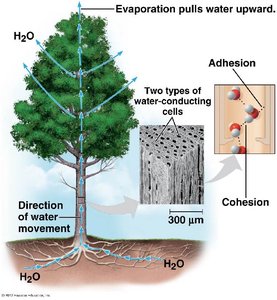
Cohesion: Water molecules stick together due to hydrogen bonding, leading to surface tension.
Adhesion: Water molecules can also stick to other substances, aiding in processes like capillary action.
High Specific Heat: Water can absorb a lot of heat before its temperature rises, helping organisms maintain stable internal temperatures.
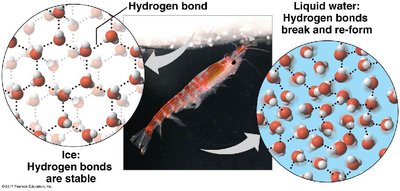
Ice Floats: Hydrogen bonds stabilize in ice, making it less dense than liquid water.
Example: Surface tension allows insects to walk on water.

Water as a Solvent
Solvent, Solute, and Solution
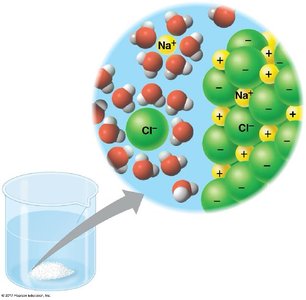
Water is known as the "universal solvent" because it can dissolve a wide variety of substances. This ability is vital for biological reactions and transport of molecules in cells.
Solvent: The substance that dissolves other substances (water in biological systems).
Solute: The substance that is dissolved (e.g., salt, sugar).
Solution: A homogeneous mixture of solvent and solute.
Types of Solutes in Water
Solutes can be categorized based on their interaction with water:
Hydrophilic: Substances that readily dissolve in water (e.g., salts, sugars).
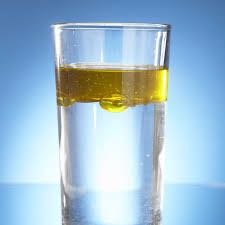
Hydrophobic: Substances that do not dissolve in water (e.g., oils).
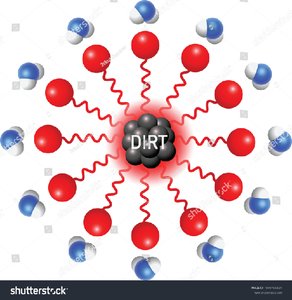
Amphipathic: Molecules with both hydrophilic and hydrophobic regions (e.g., detergents, proteins).
Ionization of Water and pH
Ionization of Water
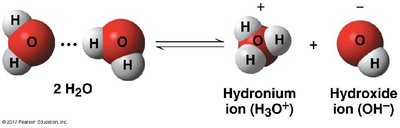
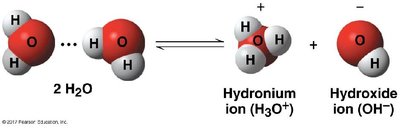
Water can ionize to form hydronium (H3O+) and hydroxide (OH-) ions. This process is fundamental to the concept of pH.
Equation:
Hydronium Ion: Formed when a water molecule gains a proton.
Hydroxide Ion: Formed when a water molecule loses a proton.
pH Scale and Solutions
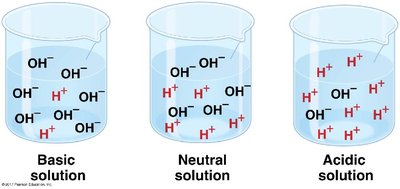
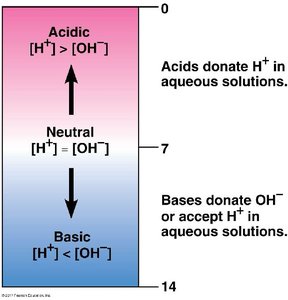
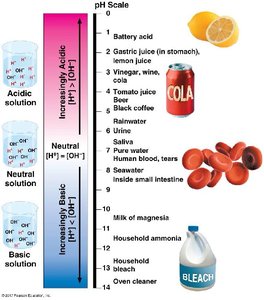
The pH scale measures the concentration of hydrogen ions in a solution, indicating its acidity or basicity.
Neutral Solution: [H+] = [OH-], pH = 7
Acidic Solution: [H+] > [OH-], pH < 7
Basic Solution: [H+] < [OH-], pH > 7
Equation:
Acids, Bases, and Buffers
Acids and bases are substances that alter the concentration of H+ and OH- in solution. Buffers help maintain stable pH in biological systems.
Acids: Donate H+ ions to solution.
Bases: Donate OH- ions or accept H+ ions.
Buffers: Substances that minimize changes in pH by absorbing or releasing H+ ions.
Example: Blood contains buffers to maintain a stable pH for proper physiological function.
Concentration and Molarity
Molarity and Molar Solutions
Concentration is often measured as molarity, which is the number of moles of solute per liter of solution. This concept is fundamental for preparing solutions in laboratory and biological contexts.
Molarity (M):
Example: 0.5 M NaCl means 0.5 moles of NaCl dissolved in enough water to make 1 liter of solution.
Application: Calculating molarity is essential for experiments and understanding cellular environments.
Term | Definition | Example |
|---|---|---|
Solvent | Substance that dissolves solute | Water |
Solute | Substance dissolved in solvent | NaCl |
Solution | Homogeneous mixture of solvent and solute | Salt water |
Molarity | Moles of solute per liter of solution | 0.5 M NaCl |
Additional info: Molarity is a key concept in biochemistry and physiology, as it allows precise control of solute concentrations for reactions and cellular processes.
