 Back
Water: Structure, Properties, and Biological Importance
Study Guide - Smart Notes
 Tailored notes based on your materials, expanded with key definitions, examples, and context.
Water is Essential for Life
Bond Types and Electronegativity
Understanding the types of chemical bonds and the concept of electronegativity is fundamental to grasping water's unique properties. Electronegativity is a measure of an atom's ability to attract electrons in a bond. The difference in electronegativity between atoms determines whether a bond is nonpolar covalent, polar covalent, or ionic.
Covalent bonds: Electrons are shared between atoms.
Nonpolar covalent bonds: Electrons are shared equally (e.g., C–C, C–H).
Polar covalent bonds: Electrons are shared unequally due to differences in electronegativity (e.g., O–H, C–O).
Ionic bonds: Electrons are transferred from one atom to another, resulting in charged ions.

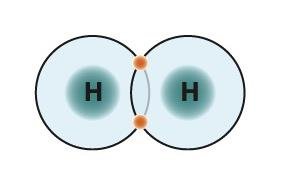
Example: The bond in H2 (hydrogen gas) is nonpolar covalent because both atoms have the same electronegativity.
Additional info: Electronegativity values: H = 2.1, O = 3.44, Cl = 3.16, Na = 0.93, C = 2.55.
Structure and Polarity of Water
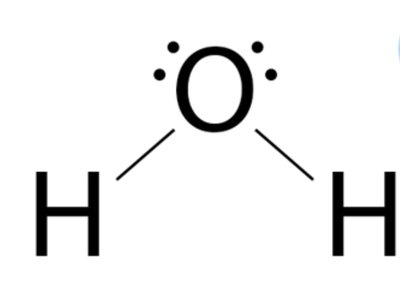
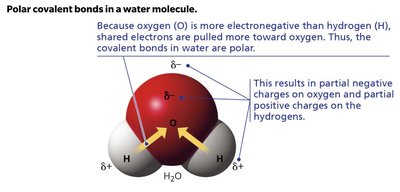
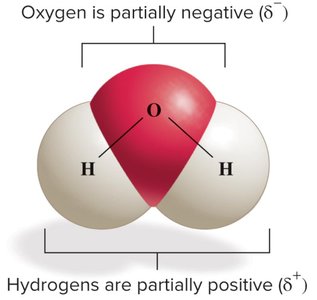
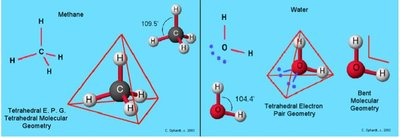
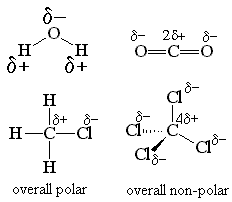
Water (H2O) is a polar molecule due to its bent shape and the difference in electronegativity between oxygen and hydrogen. The oxygen atom attracts electrons more strongly, resulting in partial negative (δ-) and partial positive (δ+) charges within the molecule.
Polar covalent bonds between O and H.
Bent molecular shape (104.5° angle).
Asymmetrical electron distribution creates polarity.
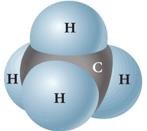
Example: Water is hydrophilic (water-loving) due to its polarity, while methane (CH4) is nonpolar and hydrophobic.
Molecular Shape and Polarity
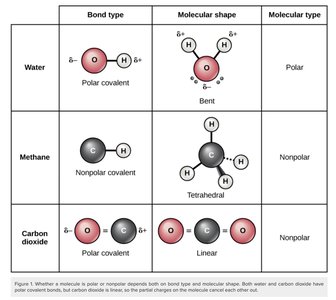
The shape of a molecule is crucial in determining its polarity. Water's bent shape leads to an uneven distribution of charge, making it polar. In contrast, molecules like carbon dioxide (CO2) are linear and symmetrical, resulting in nonpolarity despite having polar covalent bonds.
Water: Bent shape, polar.
Methane: Tetrahedral shape, nonpolar.
Carbon dioxide: Linear shape, nonpolar.
Bond type | Molecular shape | Molecular type |
|---|---|---|
Water | Bent | Polar |
Methane | Tetrahedral | Nonpolar |
Carbon dioxide | Linear | Nonpolar |
Hydrogen Bonding in Water
Formation and Properties of Hydrogen Bonds
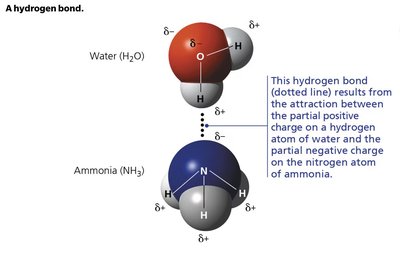
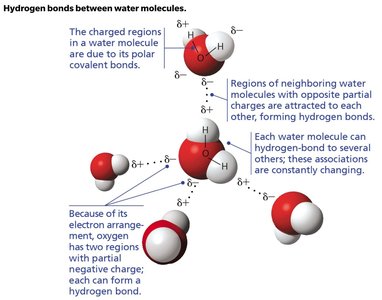
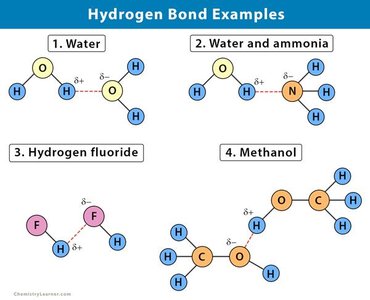
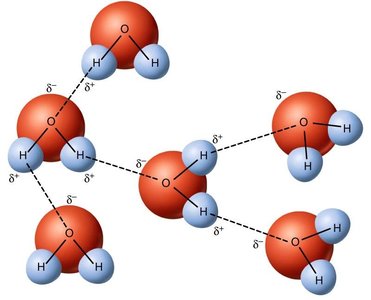
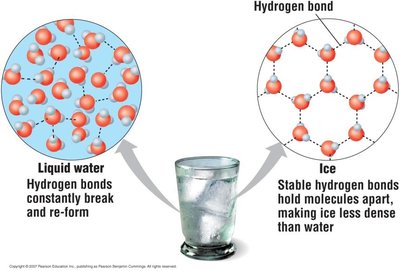
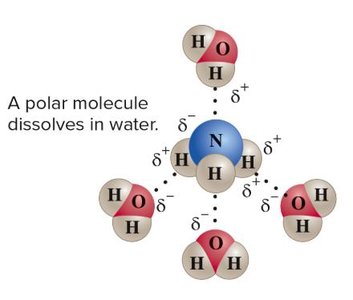
Hydrogen bonds are weak attractions between the partially positive hydrogen atom of one molecule and the partially negative atom (usually oxygen or nitrogen) of another. Although individually weak, their cumulative effect is significant in biological systems.
Hydrogen bonds are noncovalent and do not involve electron sharing.
Responsible for many emergent properties of water.
Shown as dotted or dashed lines in diagrams.
Example: Hydrogen bonds hold the two strands of DNA together and contribute to protein folding.
Emergent Properties of Water
Hydrogen bonding gives rise to several unique properties essential for life:
Cohesion: Water molecules stick to each other.
Adhesion: Water molecules stick to other polar substances.
Surface tension: Difficult to break or stretch the surface of water.
High specific heat: Water resists temperature changes.
High heat of vaporization: Water absorbs large amounts of heat to evaporate.
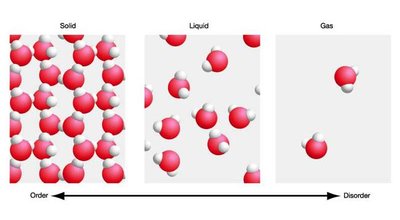
Ice floats: Solid water is less dense than liquid water due to stable hydrogen bonds.
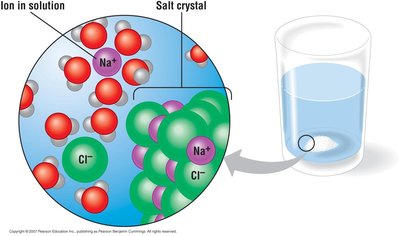
Good solvent: Water dissolves polar and ionic substances.
Water as a Solvent
Solubility of Polar and Ionic Molecules
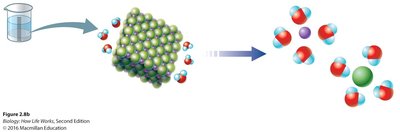
Water's polarity allows it to dissolve many substances, making it the universal solvent. Polar molecules and ions are hydrophilic and dissolve readily, while nonpolar molecules are hydrophobic and do not dissolve.
Hydrophilic: Polar molecules (e.g., salt, sugar) dissolve in water.
Hydrophobic: Nonpolar molecules (e.g., oils, lipids) do not dissolve.
Hydrophobic forces are important in biological structures like cell membranes.
pH and Water Ionization
Ionization of Water and the pH Scale
Water can ionize into hydrogen ions (H+) and hydroxide ions (OH-). The concentration of H+ determines the pH of a solution, which is a logarithmic scale.
Neutral pH: [H+] = [OH-] = 10-7 M, pH = 7.
Acids: Donate H+, lower pH.
Bases: Accept H+, raise pH.
pH formula:
Each unit change in pH represents a tenfold change in [H+].
Example: If [H+] = 0.001, then pH = 3.
Buffers and Biological Importance
Buffers are chemicals that resist changes in pH, maintaining stable conditions in biological systems. They are crucial for homeostasis in cells and organisms.
Buffer systems help maintain pH in blood, cells, and other fluids.
Example: Carbonic acid-bicarbonate buffer in blood.
Summary
Water's structure and polarity are central to its biological functions.
Hydrogen bonding leads to emergent properties essential for life.
Water is a universal solvent for polar and ionic substances.
pH is determined by water ionization and is vital for biomolecular function.
Buffers maintain pH stability in biological systems.
