 Back
Water: Structure, Properties, and Biological Importance
Study Guide - Smart Notes
 Tailored notes based on your materials, expanded with key definitions, examples, and context.
Water: Structure, Polarity, and Hydrogen Bonding
Atomic Structure and Covalent Bonds
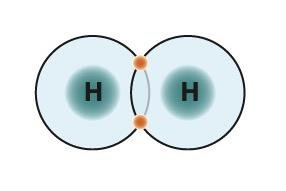
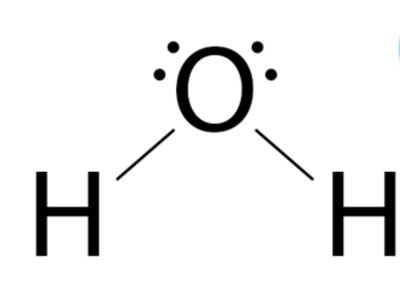
Water (H2O) is a simple molecule composed of two hydrogen atoms covalently bonded to one oxygen atom. Covalent bonds involve the sharing of electrons between atoms. In a nonpolar covalent bond, electrons are shared equally, while in a polar covalent bond, electrons are shared unequally due to differences in electronegativity.
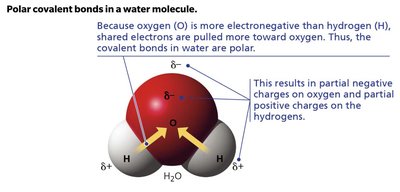
Electronegativity: The tendency of an atom to attract electrons in a bond. Oxygen is more electronegative than hydrogen, resulting in unequal sharing of electrons in water.
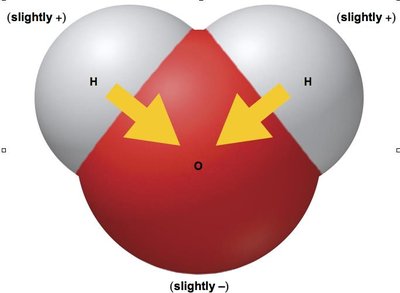
Polar Covalent Bond: In water, the oxygen atom attracts electrons more strongly, creating partial negative (δ–) and partial positive (δ+) charges.
Nonpolar Covalent Bond: Atoms like hydrogen (H2) share electrons equally.
Example: The bond in H2 is nonpolar covalent, while the bonds in H2O are polar covalent.
Polarity of Water Molecules
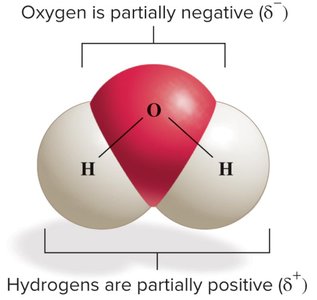
The asymmetrical shape of water and the difference in electronegativity between oxygen and hydrogen make water a polar molecule. This polarity results in distinct regions of partial positive and negative charge.
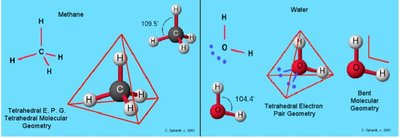
Asymmetry: The bent shape of water (104.5° bond angle) ensures that the dipoles do not cancel out, making the molecule polar.
Hydrophilic vs. Hydrophobic: Polar molecules are hydrophilic (water-loving), while nonpolar molecules are hydrophobic (water-fearing).
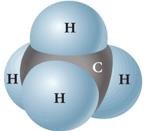
Example: Methane (CH4) is nonpolar and symmetrical, while water is polar and asymmetrical.
Comparison of Water, Methane, and Carbon Dioxide
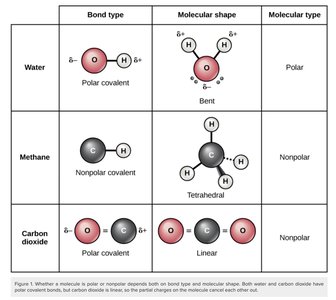
The polarity of a molecule depends on both the type of bonds and the molecular geometry. The following table summarizes the differences among water, methane, and carbon dioxide:
Bond Type | Molecular Shape | Molecular Type |
|---|---|---|
Water: Polar covalent | Bent | Polar |
Methane: Nonpolar covalent | Tetrahedral | Nonpolar |
Carbon dioxide: Polar covalent | Linear | Nonpolar |
Hydrogen Bonding and Emergent Properties of Water
Hydrogen Bonds
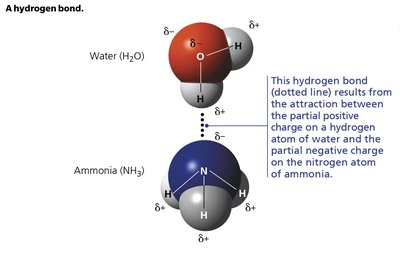
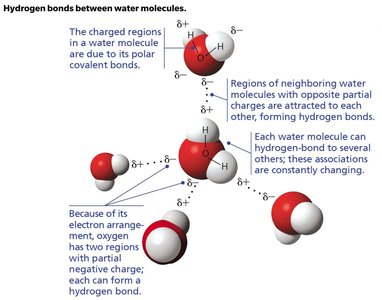
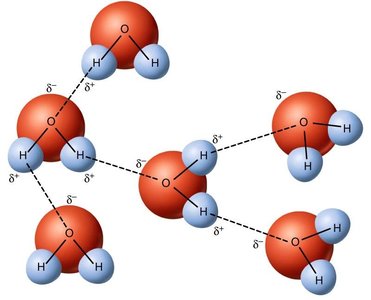
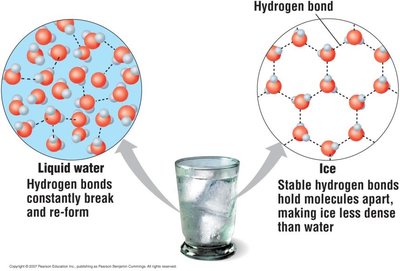
Hydrogen bonds are weak, noncovalent interactions that occur between a partially positive hydrogen atom and a partially negative atom (usually oxygen or nitrogen). Although each hydrogen bond is weak, collectively they have significant effects on the properties of water.
Formation: Hydrogen bonds form between water molecules due to their polarity.
Strength: Each hydrogen bond is about 5% as strong as a covalent bond, but many together create strong effects.
Example: Hydrogen bonds hold the two strands of DNA together and contribute to protein folding.
Emergent Properties of Water
The unique properties of water arise from hydrogen bonding and molecular polarity. These emergent properties are essential for life:
Cohesion and Adhesion: Water molecules stick to each other (cohesion) and to other polar substances (adhesion), enabling capillary action in plants.
Surface Tension: The cohesive forces at the surface of water make it difficult to break or stretch.
High Specific Heat and Heat of Vaporization: Water resists temperature changes and absorbs large amounts of heat before evaporating, stabilizing environments and organisms.
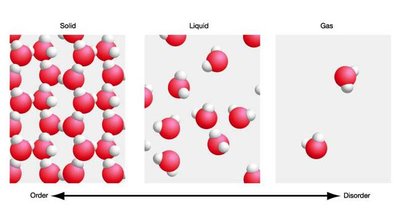
Ice Floats: Solid water (ice) is less dense than liquid water due to the stable hydrogen-bonded lattice, allowing life to persist under ice-covered surfaces.
Solvent Properties: Water dissolves many polar and ionic substances, making it the solvent of life.
Water as a Solvent
Hydrophilic and Hydrophobic Substances
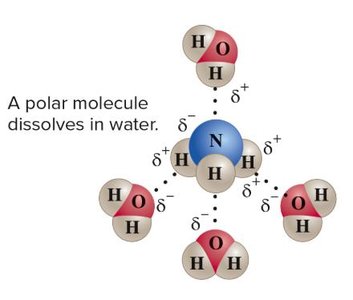
Water's polarity allows it to dissolve other polar molecules and ionic compounds (hydrophilic), but not nonpolar substances (hydrophobic). This property is crucial for biological processes such as nutrient transport and cellular structure.
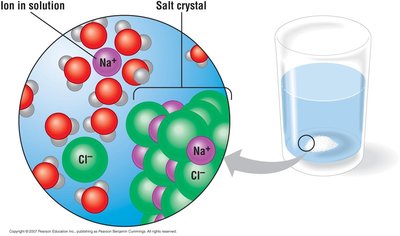
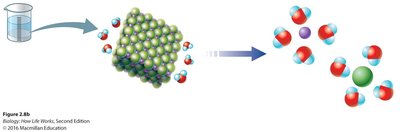
Hydration Shell: Water molecules surround ions or polar molecules, separating and dissolving them.
Example: Table salt (NaCl) dissolves in water as Na+ and Cl– ions are surrounded by water molecules.
Nonpolar Molecules: Substances like oils do not dissolve in water and are important in forming biological membranes.
pH, Acids, Bases, and Buffers
Water Ionization and the pH Scale
Water can ionize into hydrogen ions (H+) and hydroxide ions (OH–). The concentration of H+ ions determines the pH of a solution, which affects many biological processes.
pH Definition: pH is the negative logarithm (base 10) of the hydrogen ion concentration:
Neutral pH: Pure water has a pH of 7, where [H+] = [OH–] = M.
Acids: Substances that increase [H+] and lower pH.
Bases: Substances that decrease [H+] and raise pH.
Logarithmic Scale: Each pH unit represents a tenfold change in [H+].
Example Calculations:
If [H+] = 0.001 M, then
A solution of pH 3 has 1000 times more H+ than a solution of pH 6.
Buffers
Buffers are substances that minimize changes in pH by absorbing or releasing H+ ions. They are essential for maintaining stable pH in biological systems.
Example: The bicarbonate buffer system in blood helps maintain pH homeostasis.
Summary Table: Types of Bonds and Water's Role
Bond Type | Description | Biological Importance |
|---|---|---|
Polar Covalent | Unequal sharing of electrons | Creates polarity in water |
Ionic | Transfer of electrons | Formation of salts, dissolves in water |
Hydrogen Bond | Attraction between δ+ H and δ– O/N | Stabilizes DNA, proteins, water properties |
Additional info: The emergent properties of water, such as cohesion, adhesion, high specific heat, and solvent abilities, are foundational for life on Earth. The structure and function of biomolecules, cell membranes, and genetic material all depend on these properties.
