 Back
Water: Structure, Properties, and Biological Importance
Study Guide - Smart Notes
 Tailored notes based on your materials, expanded with key definitions, examples, and context.
Water is Essential for Life
Introduction to Water and Chemical Bonds
Water is a fundamental molecule for all living organisms, and its unique properties arise from its chemical structure and the types of bonds it forms. Understanding the nature of these bonds is crucial for grasping why water behaves as it does in biological systems.
Covalent bonds involve the sharing of electrons between atoms.
Nonpolar covalent bonds share electrons equally (e.g., C–C, C–H).
Polar covalent bonds share electrons unequally due to differences in electronegativity (e.g., O–H, C–O).
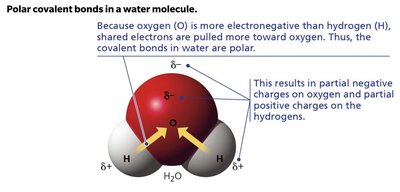
Electronegativity is the tendency of an atom to attract electrons in a bond. Oxygen is more electronegative than hydrogen, leading to unequal sharing in water molecules.

Structure and Polarity of Water
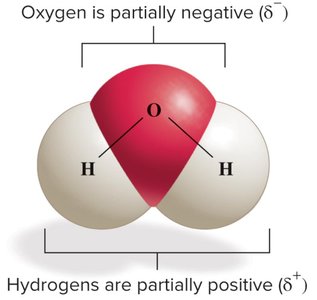
The water molecule (H2O) is asymmetrical and polar due to the difference in electronegativity between oxygen and hydrogen. This polarity is essential for many of water's properties.
Oxygen attracts electrons more strongly, resulting in a partial negative charge (δ–) on the oxygen and partial positive charges (δ+) on the hydrogens.
The molecule is bent, not linear, with a bond angle of about 104.5°.
This asymmetry makes water a polar molecule, with distinct electron-rich and electron-poor regions.
Comparison: Polar vs. Nonpolar Molecules
The shape and symmetry of a molecule, combined with the type of bonds, determine whether it is polar or nonpolar.
Water (H2O): Polar covalent bonds, bent shape, overall polar.
Methane (CH4): Nonpolar covalent bonds, tetrahedral shape, overall nonpolar.
Carbon dioxide (CO2): Polar covalent bonds, linear shape, overall nonpolar due to symmetry.
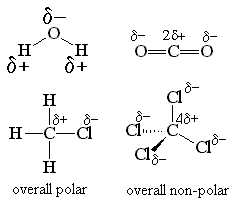
Bond type | Molecular shape | Molecular type |
|---|---|---|
Water | Bent | Polar |
Methane | Tetrahedral | Nonpolar |
Carbon dioxide | Linear | Nonpolar |
Hydrogen Bonding in Water
Nature of Hydrogen Bonds
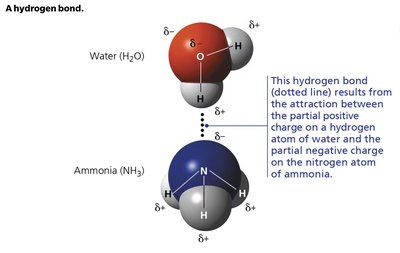
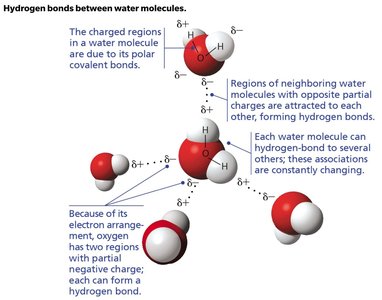
Hydrogen bonds are weak, noncovalent interactions that occur between a partially positive hydrogen atom and a partially negative atom (usually oxygen or nitrogen) in another molecule.
Each hydrogen bond is about 5% the strength of a covalent bond, but collectively they have significant effects.
Hydrogen bonds are responsible for many of water's unique properties.
Emergent Properties of Water Due to Hydrogen Bonding
Hydrogen bonding gives rise to several emergent properties that are essential for life:
Cohesion and Adhesion: Water molecules stick to each other (cohesion) and to other polar substances (adhesion), enabling processes like water transport in plants.
Surface Tension: The surface of water is difficult to break due to cohesive hydrogen bonds.
High Specific Heat and Heat of Vaporization: Water resists temperature changes and requires significant energy to vaporize, stabilizing temperatures in organisms and environments.
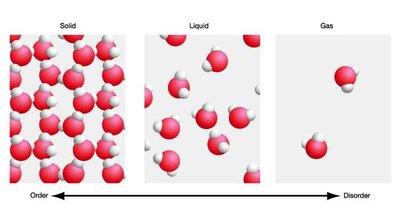
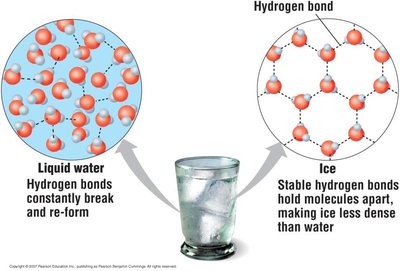
Ice Floats: Hydrogen bonds stabilize in ice, making it less dense than liquid water. This insulates aquatic life in cold climates.
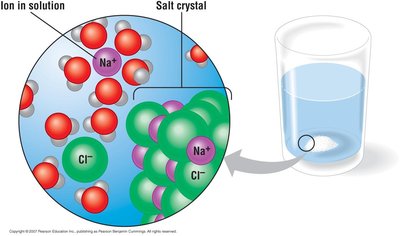
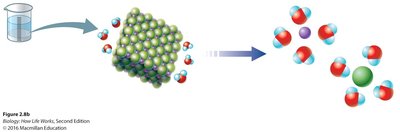
Excellent Solvent: Water dissolves many polar and ionic substances, facilitating biochemical reactions.
Water as a Solvent
Hydrophilic and Hydrophobic Substances
Water's polarity allows it to dissolve many substances, making it the "universal solvent" in biological systems.
Hydrophilic (water-loving): Polar molecules and ions dissolve easily in water (e.g., salts, sugars).
Hydrophobic (water-fearing): Nonpolar molecules do not dissolve in water (e.g., oils, fats).
Hydrophobic interactions are crucial for the structure of cell membranes and protein folding.
pH, Acids, Bases, and Buffers
Water Ionization and the pH Scale
Water can ionize into hydrogen ions (H+) and hydroxide ions (OH–). The concentration of H+ ions determines the pH of a solution.
pH is defined as the negative logarithm (base 10) of the hydrogen ion concentration:
Pure water has a neutral pH of 7, where [H+] = [OH–] = M.
The pH scale is logarithmic: a change of one pH unit equals a tenfold change in [H+].
Acids, Bases, and Buffers
Acids increase the concentration of H+ in solution, lowering pH, while bases decrease [H+], raising pH. Buffers are substances that minimize changes in pH by absorbing or releasing H+ as needed.
Acid example:
Base example:
Buffer example: The bicarbonate buffer system in blood helps maintain pH homeostasis.
Summary Table: Key Concepts
Concept | Description |
|---|---|
Covalent Bond | Atoms share electrons |
Polar Covalent Bond | Electrons shared unequally, creating partial charges |
Hydrogen Bond | Weak attraction between δ+ H and δ– O or N |
Hydrophilic | Polar, water-soluble |
Hydrophobic | Nonpolar, water-insoluble |
pH | Measure of [H+] in solution |
Buffer | Resists changes in pH |
Conclusion
Water's unique chemical and physical properties are essential for life. Its polarity, ability to form hydrogen bonds, and role as a solvent underlie many biological processes, from maintaining cell structure to regulating pH and temperature. Understanding these properties is foundational for further study in biology.
