 Back
Water: Structure, Properties, and Biological Importance
Study Guide - Smart Notes
 Tailored notes based on your materials, expanded with key definitions, examples, and context.
Water: The Indispensable Molecule for Life
The Unique Structure and Interactions of Water
Water (H2O) is the fundamental solvent of life, with unique properties arising from its molecular structure. Understanding these properties is essential for comprehending biological processes such as nutrient transport and temperature regulation.
Polar Covalent Bonds: Oxygen and hydrogen atoms in water share electrons unequally, making oxygen partially negative (δ−) and hydrogen partially positive (δ+). This polarity enables water to interact strongly with other polar molecules and ions.
Hydrogen Bonds: The partial positive hydrogen of one water molecule is attracted to the partial negative oxygen of another, forming hydrogen bonds. These bonds are weaker than covalent bonds but numerous, constantly forming and breaking in liquid water.
Biological Importance: Water's polarity and hydrogen bonding are the foundation for its emergent properties, crucial for life.
The Four Emergent Properties of Water
Water's molecular structure and hydrogen bonding give rise to four key properties that make Earth suitable for life:
Cohesive and Adhesive Behavior:
Cohesion: Water molecules stick to each other, creating surface tension. This allows lightweight organisms, like water striders, to walk on water.
Adhesion: Water molecules stick to other polar surfaces, enabling capillary action (e.g., water climbing up plant xylem).
Moderation of Temperature: Water has a high specific heat capacity, absorbing or releasing heat with minimal temperature change. This stabilizes aquatic environments and regulates climate.
Expansion Upon Freezing: Water expands when it freezes, making ice less dense than liquid water. Floating ice insulates aquatic life and contributes to mechanical weathering.
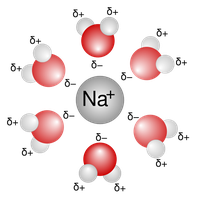
Versatility as a Solvent: Water dissolves a wide variety of substances due to its polarity, forming hydration shells around ions and polar molecules. Most biological solutions are aqueous.
Water Interactions with Other Substances: Hydrophilic and Hydrophobic
The interaction of substances with water determines their behavior in biological systems.
Hydrophilic (Water-Loving): Substances with polar covalent bonds or ionic nature dissolve in water (e.g., salts, sugars, proteins).
Hydrophobic (Water-Fearing): Nonpolar substances do not dissolve in water (e.g., oils, fats, waxes). Hydrophobic interactions are essential for forming cell membranes.
Quantifying Solutions: Concentration, Moles, and Molarity
Quantifying solutes in solutions is vital in biology and medicine.
Concentration: Amount of solute per volume of solvent or solution.
The Mole (mol): Fundamental unit representing Avogadro's number (6.02×10²³ particles).
Molecular Mass: Sum of atomic masses in a molecule, expressed in Daltons (Da) or grams per mole (g/mol).
Molarity (M): Number of moles of solute per liter of solution. Formula:
Example: To make 1.00 L of 1.00 M NaOH solution, weigh out 40 grams (molecular mass of NaOH = 40 g/mol).
Water as a Solvent: Hydration Shells
Water's polarity allows it to surround ions, separating and keeping them dissolved in solution. For example, sodium ions (Na+) are surrounded by water molecules, with the partially negative oxygen atoms facing the positive ion.
Acids, Bases, and pH
The concentration of hydrogen ions (H+) determines acidity or basicity, measured by the pH scale.
Dissociation of Water: Water molecules can dissociate into hydrogen ions (H+) and hydroxide ions (OH−), forming hydronium ions (H3O+).
Acids: Increase H+ concentration; pH < 7. Strong acids dissociate completely; weak acids partially.
Bases: Reduce H+ concentration; pH > 7. Strong bases dissociate completely; weak bases accept H+ reversibly.
pH Scale: Logarithmic scale from 0 to 14. Neutral pH is 7. Each unit change represents a tenfold change in H+ concentration.
Relationship Between pH and pOH: At 25°C, , so pH + pOH = 14.
Calculating pH and pOH:
Example: For [H+] = 0.0235 M:
pH = –log(0.0235) = 1.629
pOH = 14 – 1.629 = 12.371
Buffers: Substances that resist drastic changes in pH, often consisting of a weak acid and its corresponding weak base. Example: Carbonic acid and bicarbonate buffer system in blood.
Real-World Impact: Ocean Acidification
Excessive CO2 absorption by oceans forms carbonic acid, increasing acidity and reducing carbonate ions. This threatens marine organisms' ability to build calcium carbonate structures, impacting ecosystems and the food web.
Property | Description | Biological Importance |
|---|---|---|
Cohesion & Adhesion | Water molecules stick to each other and to other surfaces | Surface tension, capillary action in plants |
High Specific Heat | Absorbs/release heat with minimal temperature change | Stable environments, climate regulation |
Expansion Upon Freezing | Ice is less dense than liquid water | Insulates aquatic life, mechanical weathering |
Solvent Versatility | Dissolves many substances | Transport of nutrients, biochemical reactions |
Additional info: The notes expand on the emergent properties of water, the importance of solution concentration, and the impact of ocean acidification, providing context for biological and environmental relevance.
