 Back
Water: The Indispensable Molecule for Life
Study Guide - Smart Notes
 Tailored notes based on your materials, expanded with key definitions, examples, and context.
Water: The Indispensable Molecule for Life
The Unique Structure and Interactions of Water
Water (H2O) is essential for all biological systems due to its unique molecular structure and the interactions it enables. These properties underpin many processes vital for life.
Polar Covalent Bonds: In water, oxygen and hydrogen atoms share electrons unequally, making oxygen partially negative (δ−) and hydrogens partially positive (δ+). This polarity allows water to interact with other polar molecules and ions.
Hydrogen Bonds: The partial charges enable water molecules to form hydrogen bonds with each other. These bonds are weaker than covalent bonds but are numerous and dynamic, giving water its unique properties.
The Four Emergent Properties of Water
Water's molecular structure and hydrogen bonding result in four key properties that support life on Earth:
Cohesive and Adhesive Behavior:
Cohesion: Water molecules stick to each other, creating surface tension. This allows small organisms to move across water surfaces.
Adhesion: Water molecules stick to other polar substances, enabling capillary action, such as water transport in plants.
Moderation of Temperature: Water has a high specific heat capacity, absorbing or releasing large amounts of heat with minimal temperature change. This stabilizes aquatic environments and moderates climate.
Expansion Upon Freezing: Water expands as it freezes, making ice less dense than liquid water. Floating ice insulates aquatic life and contributes to geological processes like soil formation.
Versatility as a Solvent: Water dissolves a wide range of substances due to its polarity, making it the "universal solvent." Most biological reactions occur in aqueous solutions.
Water Interactions with Other Substances: Hydrophilic and Hydrophobic
The interaction of substances with water determines their behavior in biological systems:
Hydrophilic (Water-Loving): Substances with polar or ionic bonds that dissolve in water (e.g., salts, sugars, many proteins).
Hydrophobic (Water-Fearing): Nonpolar substances that do not dissolve in water (e.g., oils, fats). Hydrophobic interactions are crucial for forming cell membranes.
Quantifying Solutions: Concentration, Moles, and Molarity
Understanding solution concentration is essential in biology and chemistry:
Concentration: The amount of solute in a given volume of solvent or solution.
The Mole (mol): A unit representing 6.02 × 10²³ particles (Avogadro's number), allowing comparison of quantities at the molecular level.
Molecular Mass: The sum of atomic masses in a molecule, expressed in Daltons (Da) or grams per mole (g/mol).
Example: NaCl (Sodium Chloride): 23 (Na) + 35 (Cl) = 58 g/mol
Example: Glucose (C6H12O6): (6 × 12) + (12 × 1) + (6 × 16) = 180 g/mol
Molarity (M): The number of moles of solute per liter of solution.
Formula:
Example: 1 M NaCl = 1 mole NaCl in 1 liter of solution.
How Water Dissolves Substances
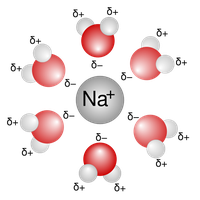
Water's polarity allows it to surround and separate ions and polar molecules, keeping them dissolved in solution. For example, in NaCl, water molecules orient so that their partially negative oxygen atoms face Na+ ions, and their partially positive hydrogen atoms face Cl− ions, effectively dissolving the salt.
Acids, Bases, and pH
The concentration of hydrogen ions (H+) in a solution determines its acidity or basicity, measured by the pH scale.
Dissociation of Water: Water can dissociate into H+ and OH− ions. These ions are reactive and their concentrations are balanced in pure water.
Acids: Substances that increase H+ concentration (pH < 7). Strong acids dissociate completely; weak acids only partially.
Bases: Substances that decrease H+ concentration (pH > 7), often by accepting H+ or releasing OH−.
pH Scale: Ranges from 0 (most acidic) to 14 (most basic), with 7 as neutral. Each unit change represents a tenfold change in H+ concentration.
Relationship Between pH and pOH: At 25°C, and .
Calculating pH and pOH:
Example: For [H+] = 0.0235 M, pH = 1.629, pOH = 12.371
Buffers: Substances that resist changes in pH by absorbing or releasing H+. Example: The carbonic acid-bicarbonate buffer system in blood maintains pH near 7.4.
Real-World Impact: Ocean Acidification
Excess atmospheric CO2 dissolves in oceans, forming carbonic acid and lowering ocean pH (ocean acidification). This reduces carbonate ion concentration, threatening marine organisms that rely on carbonate to build shells and skeletons, and disrupting marine ecosystems.
