 Back
Water: The Molecule That Supports Life – Study Notes for General Biology
Study Guide - Smart Notes
 Tailored notes based on your materials, expanded with key definitions, examples, and context.
Water: The Molecule That Supports All of Life
Overview
Water is the essential biological medium on Earth, making life possible due to its unique chemical and physical properties. Most cells are surrounded by water, and cells themselves are composed of 70–95% water. The abundance of water is a primary reason Earth is habitable.
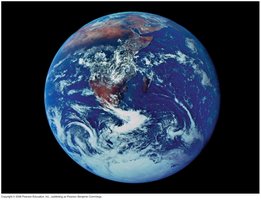
Key Point: All living organisms require water more than any other substance.
Key Point: Water's presence is crucial for cellular structure and function.
Example: Oceans, lakes, and rivers provide habitats and regulate climate.
Concept 3.1: The Polarity of Water Molecules Results in Hydrogen Bonding
Polarity and Hydrogen Bonds
Water molecules are polar, meaning they have regions of partial positive and negative charge due to oxygen's higher electronegativity compared to hydrogen. This polarity enables water molecules to form hydrogen bonds with each other, which are weak individually but strong collectively.
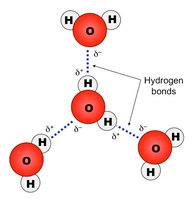
Key Point: Oxygen attracts electrons more strongly, creating a partial negative charge (O-) and partial positive charge (H+).
Key Point: Hydrogen bonds are responsible for many of water's unique properties.
Example: Water's high boiling point compared to similar molecules.
Concept 3.2: Four Emergent Properties of Water Contribute to Earth’s Fitness for Life
Emergent Properties
Water exhibits four key properties that facilitate life: cohesive behavior, ability to moderate temperature, expansion upon freezing, and versatility as a solvent.
Cohesion: Hydrogen bonds hold water molecules together, aiding transport in plants.
Adhesion: Attraction between water and other substances, such as plant cell walls.
Surface Tension: The difficulty of breaking the surface of water, related to cohesion.
Cohesion and Adhesion in Plants
Cohesion and adhesion enable water to move upward against gravity in plants, supporting transpiration and nutrient transport.
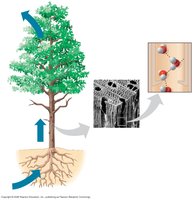
Key Point: Cohesion helps water move from roots to leaves.
Key Point: Adhesion assists water in sticking to plant cell walls.
Example: Water transport in tall trees.
Surface Tension
Surface tension allows certain organisms, such as insects, to walk on water without sinking. It is a direct result of water's cohesive properties.
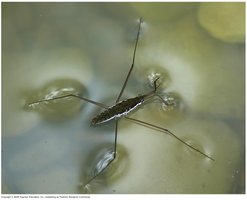
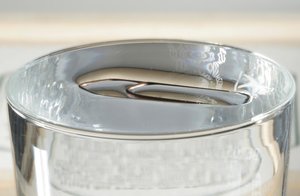
Key Point: Surface tension is higher in water than most other liquids.
Example: Water striders use surface tension to move across ponds.
Moderation of Temperature
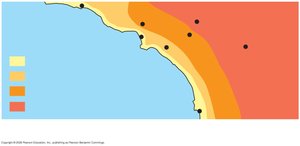
Water moderates temperature by absorbing heat from warmer air and releasing it to cooler air. Its high specific heat allows it to resist temperature changes, stabilizing environments for organisms.
Key Point: Water's high specific heat minimizes temperature fluctuations.
Example: Coastal climates are milder due to the ocean's thermal properties.
Heat and Temperature
Kinetic energy is the energy of motion. Heat is the total kinetic energy due to molecular motion, while temperature measures the intensity of heat. Water's high specific heat is defined as:
Specific Heat of Water: 1 cal/g/ºC
Formula:
Example: Water resists rapid temperature changes, protecting aquatic life.
Evaporative Cooling
Evaporation transforms liquid water into gas, cooling the remaining surface. This process stabilizes temperatures in organisms and bodies of water.
Key Point: Heat of vaporization is the energy required to convert 1 g of liquid to gas.
Example: Sweating cools the human body.
Insulation by Floating Ice
Ice floats because its hydrogen bonds are more ordered, making it less dense than liquid water. Water reaches its greatest density at 4°C. If ice sank, aquatic life would be impossible.
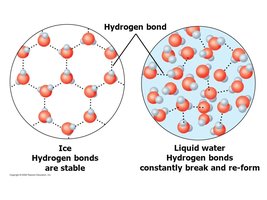
Key Point: Ice insulates bodies of water, protecting organisms below.
Example: Lakes freeze from the top down, allowing life to persist underneath.
The Solvent of Life
Water as a Solvent
Water is a versatile solvent due to its polarity, forming hydrogen bonds with solutes. Solutions are homogeneous mixtures; the solvent dissolves the solute. An aqueous solution uses water as the solvent.
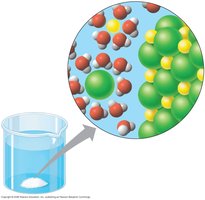
Key Point: Water dissolves ionic and polar substances efficiently.
Example: Salt dissolving in water.
Hydrophilic and Hydrophobic Substances
Hydrophilic substances have an affinity for water, while hydrophobic substances do not. Oil molecules are hydrophobic due to their nonpolar bonds.
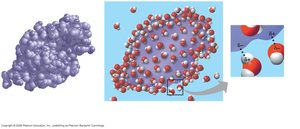
Key Point: Hydrophilic molecules interact with water; hydrophobic molecules repel it.
Example: Proteins fold differently in water versus nonaqueous environments.
Solute Concentration in Aqueous Solutions
Molarity (M) is the number of moles of solute per liter of solution. Most biochemical reactions occur in water, and their rates depend on solute concentration.
Formula:
Example: Preparing a 1 M NaCl solution for laboratory experiments.
Concept 3.3: Acidic and Basic Conditions Affect Living Organisms
Formation of Ions in Water
Hydrogen atoms in water can shift between molecules, forming hydronium (H3O+) and hydroxide (OH–) ions. This process is fundamental to acid-base chemistry.
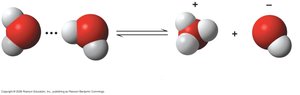
Key Point: Water can self-ionize, affecting pH.
Example: Pure water has equal concentrations of H+ and OH–.
Effects of Changes in pH
Acids increase H+ concentration, while bases reduce it. The pH scale describes the acidity or basicity of a solution, ranging from 0 (most acidic) to 14 (most basic). Most biological fluids have pH values between 6 and 8.
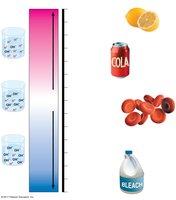
Key Point: Acidic solutions have pH < 7; basic solutions have pH > 7.
Formula:
Example: Human blood has a pH of about 7.4.
Buffers
Buffers are substances that minimize changes in pH by reversibly binding H+ ions. They are essential for maintaining stable internal conditions in living cells.
Key Point: Most buffers consist of an acid-base pair.
Example: Bicarbonate buffer system in human blood.
