 Back
Weak Bonds, Properties of Water, and pH: Study Guide for General Biology
Study Guide - Smart Notes
 Tailored notes based on your materials, expanded with key definitions, examples, and context.
Weak Bonds, Properties of Water, and pH
Overview
This study guide covers the fundamental chemical properties of water, the nature of weak chemical bonds, and the concept of pH. These topics are essential for understanding biological processes at the molecular level.
Bond Types and Strengths
Intramolecular vs. Intermolecular Forces
Atoms and molecules interact through various types of chemical bonds, which differ in strength and biological significance.
Intramolecular bonds: Bonds within a molecule, such as covalent bonds.
Intermolecular bonds: Bonds between molecules, including hydrogen bonds, ionic bonds in water, dipole-dipole interactions, and hydrophobic interactions.
Bond Strengths Table:
Type of Bond | Bond Strength (kcal/mol) | Examples and Comments |
|---|---|---|
Covalent | 50-110 | Very stable; backbone of macromolecules |
Ionic (non-polar solvent) | ~50 | Strong in crystals; varies with charge and distance |
Ionic (in water) | 5-10 | Weak in water |
Ion/dipole interaction | 7-8 | Hydration sphere |
Dipole/Dipole | 5-8 | Polar molecules |
Hydrogen | 3-5 | Water |
Hydrophobic interactions | 1-5 | Membranes |
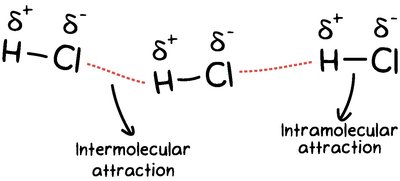
Hydrogen Bonding
Electronegativity and Hydrogen Bonds
Hydrogen bonds are a type of weak intermolecular force that occurs when a hydrogen atom covalently bonded to an electronegative atom (such as oxygen or nitrogen) is attracted to another electronegative atom. This is crucial for the structure and function of biological molecules.
Electronegativity: The tendency of an atom to attract electrons. Oxygen is highly electronegative, making water molecules polar.
Hydrogen bond donor: The hydrogen atom attached to an electronegative atom.
Hydrogen bond acceptor: The electronegative atom with a lone pair of electrons.
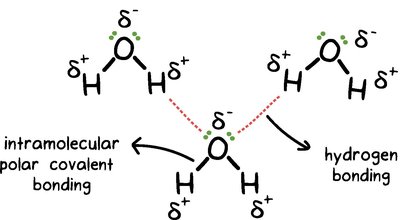
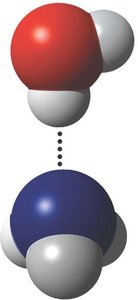
Hydrogen Bonding in Water and Ammonia
Water's polarity allows it to form hydrogen bonds with other molecules, such as ammonia. This interaction is fundamental to many biological processes.
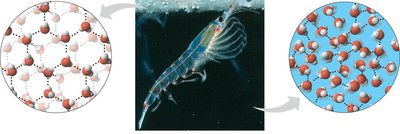
Hydrogen bonds are dynamic in liquid water, constantly breaking and reforming.
In ice, hydrogen bonds are stable, creating a rigid structure.
Emergent Properties of Water
Cohesion and Adhesion
Water's polarity and hydrogen bonding give rise to several emergent properties that are vital for life.
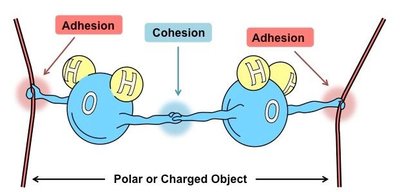
Cohesion: Water molecules stick to each other due to hydrogen bonding.
Adhesion: Water molecules stick to other polar or charged surfaces.
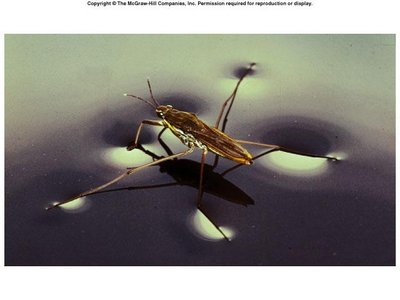
Surface tension: The cohesive forces at the surface of water allow certain organisms, like water striders, to stay afloat.
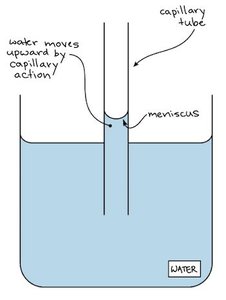
Capillary action: The combination of cohesion and adhesion enables water to move up narrow tubes, important in plant transport.
High Specific Heat, High Heat of Vaporization, and High Melting/Boiling Points
Water requires a large amount of energy to change temperature or state due to extensive hydrogen bonding. This stabilizes environmental and biological temperatures.
Specific heat: Amount of heat needed to raise the temperature of water.
Heat of vaporization: Energy required to convert water from liquid to gas.
Example: Water moderates climate and helps organisms maintain homeostasis.
Hydrophobic Interactions
Hydrophobic vs. Hydrophilic Substances
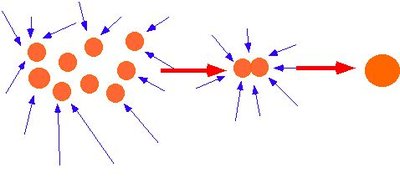
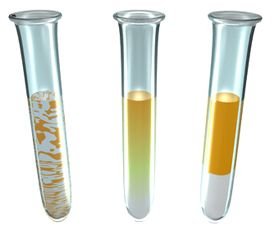
Hydrophobic interactions occur when nonpolar molecules aggregate in water, minimizing their contact with polar water molecules. Hydrophilic substances, in contrast, interact readily with water.
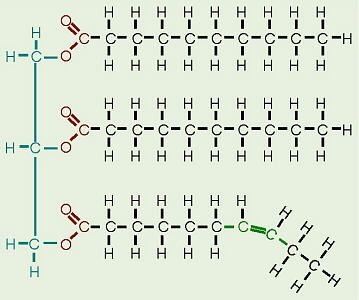
Hydrophobic: "Water hating"; nonpolar molecules (e.g., oils) do not dissolve in water.
Hydrophilic: "Water loving"; polar or ionic molecules dissolve in water.
Amphipathic: Molecules with both hydrophobic and hydrophilic regions (e.g., lipids).
Solubility of Water
Water as a Solvent
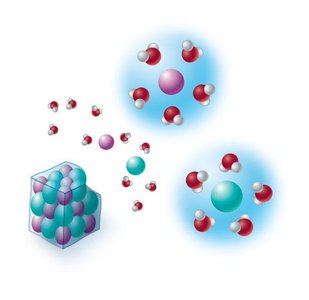
Water dissolves polar and ionic compounds by surrounding them with hydration spheres, separating ions and keeping them in solution.
Ion-dipole interactions: Attraction between a charged ion and a polar water molecule.
Hydration sphere: Water molecules surround ions, stabilizing them in solution.
Hydrophilic and Hydrophobic Surfaces
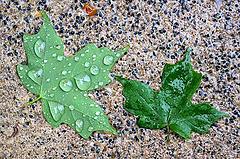
Hydrophilic surfaces form bonds with water, while hydrophobic surfaces do not. This affects solubility and biological interactions.
Hydrophilic: Polar molecules, molecules with ionic bonds.
Hydrophobic: Largely non-polar molecules (e.g., many C-H bonds).
pH and Water Ionization
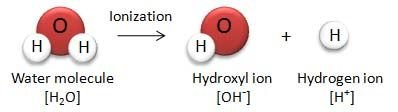
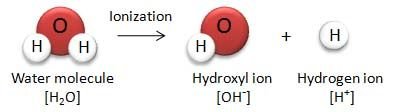
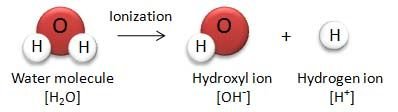
Dissociation of Water
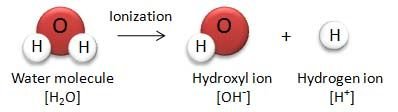
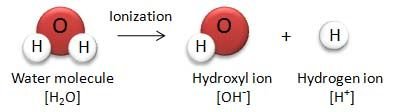
Water can dissociate into hydrogen ions (H+) and hydroxyl ions (OH-), affecting the pH of solutions.
Acid: Increases [H+] in solution.
Base: Reduces [H+] in solution.
Equation:
pH Calculation and Scale
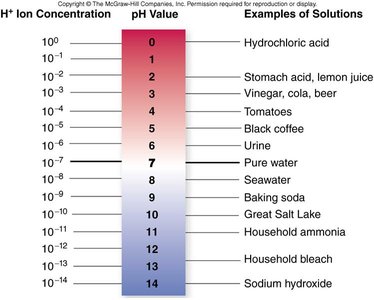
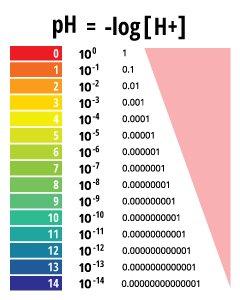
The pH of a solution is a measure of its hydrogen ion concentration, calculated using the following equation:
Pure water: , so pH = 7 (neutral)
Relating pH to [H+]
The pH scale is logarithmic, meaning each unit change represents a tenfold change in [H+].
[H+] | log [H+] | -log [H+] (pH) |
|---|---|---|
10-7 | -7 | 7 |
10-6 | -6 | 6 |
10-5 | -5 | 5 |
10-10 | -10 | 10 |
pOH and Relationship to pH
pOH is a measure of hydroxyl ion concentration. At room temperature, pH and pOH always add up to 14.
For pure water: , so pOH = 7
pH + pOH = 14
Example: Solution with pH 4 has pOH 10
Summary Table: Hydrophilic vs. Hydrophobic Substances
Type | Types of Molecules | Reaction with Water | Other Comments |
|---|---|---|---|
Hydrophobic | Largely non-polar (e.g., C-H bonds) | Cannot react with water (uncharged) | Can lead to hydrophobic interactions |
Hydrophilic | Polar molecules, molecules with ionic bonds | Can react with water (partial charges allow hydrogen bonds) | Form bonds with water |
Additional info: The concepts of weak bonds, water properties, and pH are foundational for understanding cell structure, metabolism, and biochemical reactions in biology.
