Pearson+ LogoPearson+ Logo
Ch. 1 - Biology: The Study of Life
Freeman - Biological Science 7th Edition
Freeman7th EditionBiological ScienceISBN: 9783584863285Not the one you use?Change textbook
Chapter 1, Problem 9

A friend tells you that the theory of evolution is just an educated guess by biologists about how things work. Evaluate this statement.

Verified step by step guidance
1
Understand the definition of a scientific theory: A scientific theory is a well-substantiated explanation of some aspect of the natural world, based on a body of facts that have been repeatedly confirmed through observation and experimentation.
Recognize the evidence supporting the theory of evolution: The theory of evolution is supported by a wide range of evidence from various fields such as genetics, paleontology, embryology, and comparative anatomy.
Differentiate between a theory and a hypothesis: A hypothesis is an initial assumption or educated guess that can be tested through scientific methods. A theory, on the other hand, is a hypothesis that has been extensively tested and validated by a significant amount of evidence.
Consider the scientific consensus: The theory of evolution is widely accepted by the scientific community as the best explanation for the diversity of life on Earth, based on the overwhelming evidence and its ability to predict biological phenomena.
Evaluate the use of the term 'educated guess': Referring to the theory of evolution as an 'educated guess' undermines the extensive research and empirical data that support it. It is more accurate to describe it as a well-established scientific theory.

Verified video answer for a similar problem:

This video solution was recommended by our tutors as helpful for the problem above.
Video duration:
3m
Was this helpful?

Key Concepts

Here are the essential concepts you must grasp in order to answer the question correctly.

Theory of Evolution

The theory of evolution, primarily formulated by Charles Darwin, posits that species change over time through processes such as natural selection and genetic drift. It is a well-supported scientific framework that explains the diversity of life on Earth, based on extensive evidence from various fields, including genetics, paleontology, and comparative anatomy.
Recommended video:
Guided course
06:58
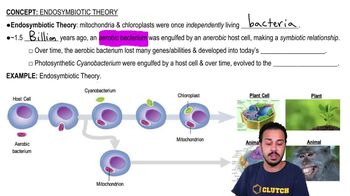
Endosymbiotic Theory

Scientific Theory vs. Hypothesis

In science, a theory is a comprehensive explanation of an aspect of nature that is supported by a vast body of evidence and has withstood rigorous testing. In contrast, a hypothesis is a tentative explanation that can be tested through experimentation. The theory of evolution is not merely an 'educated guess' but a robust scientific theory that integrates numerous observations and experiments.
Recommended video:
Guided course
08:22
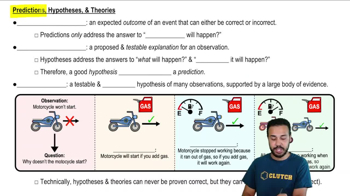
Predictions, Hypotheses, & Theories

Evidence for Evolution

Evidence for evolution includes fossil records, genetic similarities among species, and observable evolutionary changes in populations. This evidence demonstrates how species adapt to their environments over time and supports the idea that all life shares a common ancestry. Such evidence is critical in validating the theory of evolution as a fundamental principle of biology.
Recommended video:
02:27
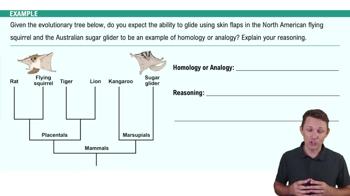
Evidence of Evolution Example 1