Pearson+ LogoPearson+ Logo
Ch. 10 - Photosynthesis
Freeman - Biological Science 7th Edition
Freeman7th EditionBiological ScienceISBN: 9783584863285Not the one you use?Change textbook
Chapter 10, Problem 9

Predict how the following conditions would affect the production of O2, ATP, and NADPH and state whether noncyclic or cyclic electron flow would occur in each: (1) Only blue photons hit a chloroplast

Verified step by step guidance
1
Identify the role of photons in photosynthesis: Photons, particularly those from light, are essential in driving the light-dependent reactions of photosynthesis where light energy is converted into chemical energy in the form of ATP and NADPH, and oxygen (O2) is produced as a byproduct.
Understand the impact of blue photons: Blue photons have higher energy compared to other wavelengths of light. This high energy is particularly effective at exciting electrons in the chlorophyll molecules found in the photosystems of chloroplasts, which is crucial for the initiation of the light-dependent reactions.
Analyze the effect on oxygen production: The excitation of electrons by blue photons leads to the splitting of water molecules in the light-dependent reactions, a process known as photolysis. This results in the production of oxygen (O2).
Consider the production of ATP and NADPH: The high energy of blue photons efficiently drives the electrons through the electron transport chain from Photosystem II to Photosystem I, leading to the generation of a proton gradient that facilitates the synthesis of ATP via chemiosmosis and the reduction of NADP+ to NADPH.
Determine the type of electron flow: Given the efficient excitation by blue photons and the involvement of both Photosystem I and II, noncyclic electron flow is likely to occur, resulting in the production of both ATP and NADPH.

Verified video answer for a similar problem:

This video solution was recommended by our tutors as helpful for the problem above.
Video duration:
5m
Was this helpful?

Key Concepts

Here are the essential concepts you must grasp in order to answer the question correctly.

Photosynthesis

Photosynthesis is the process by which green plants, algae, and some bacteria convert light energy into chemical energy, primarily in the form of glucose. It occurs in two main stages: the light-dependent reactions, which capture energy from sunlight to produce ATP and NADPH, and the light-independent reactions (Calvin cycle), which use ATP and NADPH to synthesize glucose from carbon dioxide.
Recommended video:
Guided course
05:58
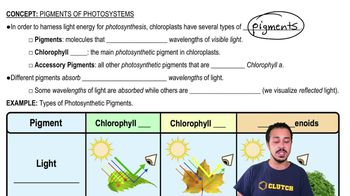
Pigments of Photosynthesis

Chlorophyll and Light Absorption

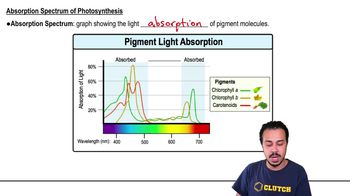
Chlorophyll is the green pigment found in chloroplasts that plays a crucial role in photosynthesis by absorbing light, primarily in the blue and red wavelengths. When only blue photons are present, chlorophyll can effectively absorb this light, leading to the excitation of electrons and the initiation of the light-dependent reactions, which are essential for producing ATP and NADPH.
Recommended video:
Guided course
02:52
Absorption Spectrum of Photosynthesis

Electron Transport Chain

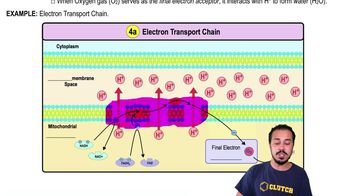
The electron transport chain (ETC) is a series of protein complexes located in the thylakoid membrane of chloroplasts that facilitate the transfer of electrons derived from light absorption. In noncyclic electron flow, electrons are transferred from water to NADP+, producing NADPH, while ATP is generated through photophosphorylation. In cyclic electron flow, electrons are recycled back to the ETC, primarily producing ATP without generating NADPH.
Recommended video:
Guided course
07:41
Electron Transport Chain
Related Practice
Textbook Question
Describe the three phases of the Calvin cycle and how the products of the light-capturing reactions participate in this process.
1600
views
Textbook Question

Apply what you know of the relationship between the light-capturing reactions and the Calvin cycle to calculate the number of photons used to produce a new G3P and regenerate RuBP. (Assume 1 ATP is produced for each pair of electrons used to form NADPH.)

711
views
Textbook Question

Which of the following correctly identify a role of the ATP produced in the light-capturing reactions? Select True or False for each statement.

T/F It is used by rubisco to fix CO2 to RuBP.

T/F It serves the same role as ATP produced by mitochondria.

T/F It is used to regenerate RuBP from G3P molecules.

T/F It is used to produce G3P molecules

977
views
Textbook Question

Predict how the following conditions would affect the production of O2, ATP, and NADPH and state whether noncyclic or cyclic electron flow would occur in each:

(1) Only blue photons hit a chloroplast

761
views
Textbook Question

Predict how the following conditions would affect the production of O2, ATP, and NADPH and state whether noncyclic or cyclic electron flow would occur in each:

(2) blue and red photons hit a chloroplast, but no NADP+ is available

1078
views
Textbook Question

Predict how the following conditions would affect the production of O2, ATP, and NADPH and state whether noncyclic or cyclic electron flow would occur in each:

(3) blue and red photons hit a chloroplast, but a proton channel has been introduced into the thylakoid membrane, so it is fully permeable to protons.

1145
views