Pearson+ LogoPearson+ Logo
Ch. 13 - Meiosis
Freeman - Biological Science 7th Edition
Freeman7th EditionBiological ScienceISBN: 9783584863285Not the one you use?Change textbook
Chapter 13, Problem 1

What are homologous chromosomes?
a. Chromosomes that are similar in their size, shape, and gene content
b. Similar chromosomes that are found in different individuals of the same species
c. The two chromatids in a replicated chromosome
d. Any chromosome in a diploid cell

Verified step by step guidance
1
Understand the concept of homologous chromosomes: Homologous chromosomes are pairs of chromosomes in a diploid organism that have the same structure and carry the same genes, although they may have different alleles.
Consider the characteristics of homologous chromosomes: They are similar in size, shape, and gene content, which means they carry genes for the same traits at the same loci.
Differentiate homologous chromosomes from other chromosome types: Unlike sister chromatids, which are identical copies of a single chromosome, homologous chromosomes come from different parents and may have different alleles.
Evaluate the options given in the problem: Compare each option to the definition and characteristics of homologous chromosomes.
Select the option that best matches the definition of homologous chromosomes: Based on the understanding that homologous chromosomes are similar in size, shape, and gene content, choose the correct answer.

Verified video answer for a similar problem:

This video solution was recommended by our tutors as helpful for the problem above.
Video duration:
1m
Was this helpful?

Key Concepts

Here are the essential concepts you must grasp in order to answer the question correctly.

Homologous Chromosomes

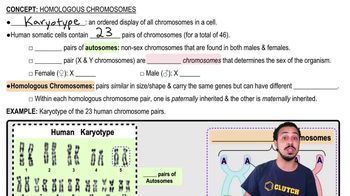
Homologous chromosomes are pairs of chromosomes in a diploid organism that are similar in size, shape, and gene content. Each pair consists of one chromosome inherited from the mother and one from the father, and they carry the same types of genes at the same loci, although the alleles may differ.
Recommended video:
Guided course
08:09
Homologous Chromosomes

Diploid Cells

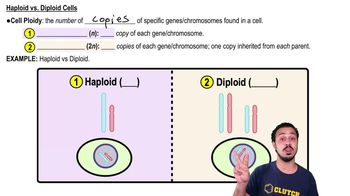
Diploid cells contain two complete sets of chromosomes, one from each parent. This is the typical chromosome number in somatic cells of organisms that reproduce sexually, allowing for genetic diversity through recombination during meiosis.
Recommended video:
Guided course
04:14
Haploid vs. Diploid Cells

Chromatids

Chromatids are the two identical halves of a replicated chromosome, connected by a centromere. During cell division, chromatids separate to ensure each new cell receives the correct number of chromosomes, maintaining genetic consistency across cells.
Recommended video:
Guided course
03:56
Eukaryotic Chromatin Modifications