Pearson+ LogoPearson+ Logo
Ch. 14 - Mendel and the Gene
Freeman - Biological Science 7th Edition
Freeman7th EditionBiological ScienceISBN: 9783584863285Not the one you use?Change textbook
Chapter 14, Problem 17

Recall that hemophilia is an X-linked recessive disease. If a woman with hemophilia had children with a man without hemophilia, what is the chance that their first child will have the disease? What is the chance that their first child will be a carrier?

Verified step by step guidance
1
Identify the genotypes of the parents. The mother has hemophilia and is therefore homozygous recessive (XhXh). The father does not have hemophilia and has a normal X chromosome, so his genotype is XY.
Set up a Punnett square with the mother's alleles on one side (Xh and Xh) and the father's alleles on the other side (X and Y).
Fill in the Punnett square to determine the possible genotypes of the offspring. The combinations will be XhX from the mother and X, and XhY from the mother and Y.
Analyze the genotypes of the offspring to determine the probability of each. XhX (daughter with hemophilia) and XhY (son with hemophilia) are the possible genotypes for a child with the disease. XhX (daughter carrier) and XY (son normal) are the possible genotypes for a child who is a carrier or normal.
Calculate the probability of each scenario: having the disease (XhX or XhY) and being a carrier (XhX). Since each child has an equal chance of inheriting each allele, the probability of each genotype can be determined from the Punnett square.

Verified video answer for a similar problem:

This video solution was recommended by our tutors as helpful for the problem above.
Video duration:
48s
Was this helpful?

Key Concepts

Here are the essential concepts you must grasp in order to answer the question correctly.

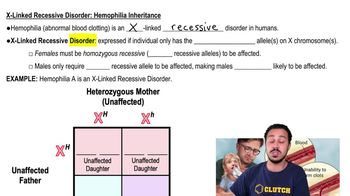
X-linked Recessive Inheritance

X-linked recessive inheritance refers to a pattern of genetic transmission where a gene causing a trait or disorder is located on the X chromosome. Males, having one X and one Y chromosome, are more likely to express X-linked recessive traits because they have only one copy of the X chromosome. Females, with two X chromosomes, can be carriers if they have one affected X chromosome and one normal X chromosome, potentially passing the trait to their offspring.
Recommended video:
Guided course
04:37
X-Linked Recessive Disorder: Hemophilia Inheritance

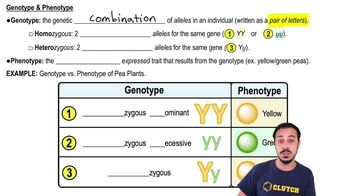
Genotype and Phenotype

Genotype refers to the genetic constitution of an individual, specifically the alleles they possess for a particular gene. Phenotype, on the other hand, is the observable expression of the genotype, influenced by both genetic and environmental factors. In the context of hemophilia, the genotype of the parents will determine the likelihood of their children inheriting the disease or being carriers, affecting their phenotype.
Recommended video:
Guided course
06:36
Genotype & Phenotype

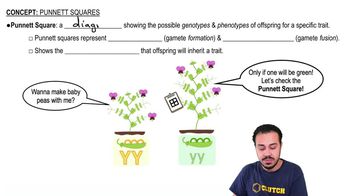
Punnett Square

A Punnett square is a diagram used to predict the genetic outcomes of a cross between two individuals. It allows for the visualization of how alleles from each parent combine to produce potential genotypes in their offspring. By filling out a Punnett square for the woman with hemophilia (XhX) and the man without hemophilia (XY), one can easily determine the probabilities of their child being affected by hemophilia or being a carrier.
Recommended video:
Guided course
01:37
Punnett Squares