Pearson+ LogoPearson+ Logo
Ch. 14 - Mendel and the Gene
Freeman - Biological Science 7th Edition
Freeman7th EditionBiological ScienceISBN: 9783584863285Not the one you use?Change textbook
Chapter 14, Problem 10b

The smooth feathers on the back of the neck in pigeons can be reversed by a mutation to produce a 'crested' appearance in which feathers form a distinctive spike at the back of the head. A pigeon breeder examined offspring produced by a single pair of non-crested birds and recorded the following: 22 non-crested and 7 crested. She then made a series of crosses using offspring from the first cross. When she crossed two of the crested birds, all 20 of the offspring were crested. When she crossed a non-crested bird with a crested bird, 7 offspring were non-crested and 6 were crested. Which allele is dominant?

Verified step by step guidance
1
Identify the phenotypes and genotypes: Non-crested is the phenotype observed in the majority in the first cross, suggesting it might be the dominant trait. However, further analysis of other crosses is needed to confirm. Crested phenotype appears less frequently initially.
Analyze the first cross: The ratio of non-crested to crested (22 non-crested:7 crested) suggests a possible 3:1 ratio, typical of a monohybrid cross where the non-crested trait would be dominant if one parent is heterozygous and the other is homozygous recessive.
Examine the second cross results: All offspring (20) from two crested birds are crested, indicating that crested is likely a recessive trait, as two recessive alleles (cc x cc) would consistently produce a recessive phenotype.
Evaluate the third cross results: The cross between a non-crested and a crested bird producing both non-crested and crested offspring (7 non-crested:6 crested) suggests a 1:1 ratio, typical when a heterozygous dominant (Nc) is crossed with a homozygous recessive (cc).
Conclude which allele is dominant: Based on the crosses, the non-crested phenotype is dominant (N), and the crested phenotype is recessive (c). The non-crested birds in the initial pair were likely heterozygous (Nc), carrying the recessive crested allele.

Verified video answer for a similar problem:

This video solution was recommended by our tutors as helpful for the problem above.
Video duration:
6m
Was this helpful?

Key Concepts

Here are the essential concepts you must grasp in order to answer the question correctly.

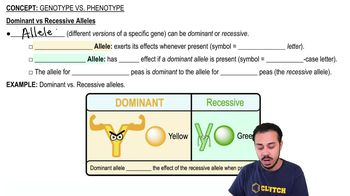
Dominant and Recessive Alleles

In genetics, alleles are different forms of a gene that can exist at a specific locus on a chromosome. A dominant allele is one that expresses its trait even when only one copy is present, while a recessive allele requires two copies to express its trait. In this case, the presence of crested offspring when crossed with non-crested birds suggests that the crested trait is likely dominant.
Recommended video:
Guided course
03:39
Dominant vs. Recessive Alleles

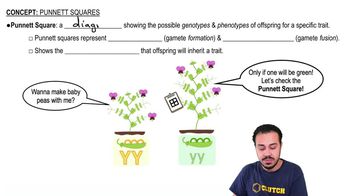
Punnett Squares

A Punnett square is a diagram used to predict the genotypes of offspring from a genetic cross. It helps visualize the possible combinations of alleles from the parents. By analyzing the ratios of offspring phenotypes, one can infer the dominance of alleles. In this scenario, the ratios of crested to non-crested offspring can be analyzed using a Punnett square to determine the inheritance pattern.
Recommended video:
Guided course
01:37
Punnett Squares

Mendelian Inheritance

Mendelian inheritance refers to the patterns of inheritance first described by Gregor Mendel, which include the principles of segregation and independent assortment. These principles explain how alleles segregate during gamete formation and how traits are inherited independently. Understanding these principles is crucial for interpreting the results of the pigeon crosses and determining which allele is dominant based on the observed offspring ratios.
Recommended video:
Guided course
02:27
Polygenic Inheritance
Related Practice
Textbook Question

In parakeets, two autosomal genes that are located on different chromosomes control the production of feather pigment. Gene B codes for an enzyme that is required for the synthesis of a blue pigment, and gene Y codes for an enzyme required for the synthesis of a yellow pigment. Green results from a mixture of yellow and blue pigments, and recessive mutations that prevent production of either pigment are known for both genes. Suppose that a breeder has two green parakeets and mates them. The offspring are green, blue, yellow, and albino (unpigmented).

Based on this observation, what are the genotypes of the green parents?

What genotypes produce each color in the offspring? What fraction of the progeny should exhibit each type of color?

845
views
Textbook Question
In parakeets, two autosomal genes that are located on different chromosomes control the production of feather pigment. Gene B codes for an enzyme that is required for the synthesis of a blue pigment, and gene Y codes for an enzyme required for the synthesis of a yellow pigment. Green results from a mixture of yellow and blue pigments, and recessive mutations that prevent production of either pigment are known for both genes. Suppose that a breeder has two green parakeets and mates them. The offspring are green, blue, yellow, and albino (unpigmented). Based on this observation, what are the genotypes of the green parents? What genotypes produce each color in the offspring? What fraction of the progeny should exhibit each type of color?
1153
views
Textbook Question

The smooth feathers on the back of the neck in pigeons can be reversed by a mutation to produce a 'crested' appearance in which feathers form a distinctive spike at the back of the head. A pigeon breeder examined offspring produced by a single pair of non-crested birds and recorded the following: 22 non-crested and 7 crested. She then made a series of crosses using offspring from the first cross. When she crossed two of the crested birds, all 20 of the offspring were crested. When she crossed a non-crested bird with a crested bird, 7 offspring were non-crested and 6 were crested. For these three crosses, provide genotypes for parents and offspring that are consistent with these results.

936
views
Textbook Question

As a genetic counselor, you advise couples about the possibility of genetic disease in their offspring. Today you met with an engaged couple, both of whom are phenotypically normal. The man, however, has a brother who died of Duchenne-type muscular dystrophy, an X-linked recessive condition. His fiancée, whose family has no history of the disease, is worried that the couple's sons or daughters might be afflicted. How would you advise this couple?

1112
views
Textbook Question

As a genetic counselor, you advise couples about the possibility of genetic disease in their offspring. Today you met with an engaged couple, both of whom are phenotypically normal. The man, however, has a brother who died of Duchenne-type muscular dystrophy, an X-linked recessive condition. His fiancée, whose family has no history of the disease, is worried that the couple's sons or daughters might be afflicted. The sister of this man is planning to marry his fiancée's brother. How would you advise this second couple?

958
views
Textbook Question
Suppose you are heterozygous for two genes that are located on different chromosomes. You carry alleles A and a for one gene and alleles B and b for the other. Draw a diagram illustrating what happens to these genes and alleles when meiosis occurs in your reproductive tissues.
971
views