
Pearson+ LogoPearson+ Logo
Ch. 2 - Water and Carbon: The Chemical Basis of Life
Freeman - Biological Science 7th Edition
Freeman7th EditionBiological ScienceISBN: 9783584863285Not the one you use?Change textbook
Chapter 2, Problem 5

Which of these molecules would you predict to have the largest number of polar covalent bonds based on their molecular formulas?a. C2H6O(ethanol)b. C2H6(ethane)c. C2H4O2(aceticacid)d. C3H8O (propanol)

Verified step by step guidance
1
Identify the presence of oxygen (O) in the molecular formulas, as oxygen is more electronegative than carbon (C) and hydrogen (H), leading to polar covalent bonds.
Count the number of oxygen atoms in each molecule, as more oxygen atoms generally indicate more opportunities for polar covalent bonds.
Consider the specific structure of each molecule, noting that functional groups like hydroxyl (OH) and carboxyl (COOH) contain polar covalent bonds.
Compare the number of these functional groups in each molecule, as molecules with more of these groups will have more polar covalent bonds.
Predict that the molecule with the highest number of oxygen atoms and functional groups that promote polarity will have the largest number of polar covalent bonds.

Verified video answer for a similar problem:

This video solution was recommended by our tutors as helpful for the problem above.
Video duration:
3m
Was this helpful?

Key Concepts

Here are the essential concepts you must grasp in order to answer the question correctly.

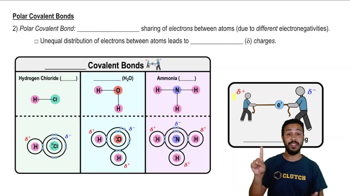
Polar Covalent Bonds

Polar covalent bonds occur when two atoms share electrons unequally due to differences in their electronegativities. This results in a partial positive charge on one atom and a partial negative charge on the other, creating a dipole. Molecules with polar covalent bonds often have functional groups like hydroxyl (-OH) or carboxyl (-COOH), which influence their chemical properties and interactions.
Recommended video:
Guided course
06:59
Polar Covalent Bonds

Molecular Formula Analysis

A molecular formula provides information about the number and types of atoms in a molecule, which can help predict the presence of polar covalent bonds. By analyzing the formula, one can identify functional groups that typically contain polar bonds. For example, the presence of oxygen or nitrogen atoms often indicates potential polar covalent bonding due to their higher electronegativity compared to carbon and hydrogen.
Recommended video:
05:13
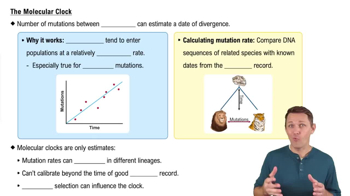
The Molecular Clock

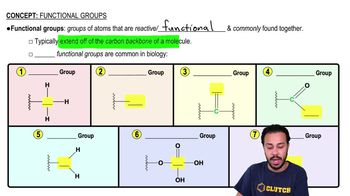
Functional Groups

Functional groups are specific groups of atoms within molecules that are responsible for the characteristic chemical reactions of those molecules. Common functional groups that contain polar covalent bonds include hydroxyl (-OH) and carboxyl (-COOH). Understanding these groups is essential for predicting the polarity of a molecule and its solubility in water, which is crucial for biological processes.
Recommended video:
Guided course
06:04
Functional Groups
Related Practice
Textbook Question

What are the defining characteristics of a condensation reaction?

a. Two monomers are covalently bonded together and a water molecule is produced.

b. Two monomers are covalently bonded together and a water molecule is used up.

c. A polymer is broken down into monomers and a water molecule is produced.

d. A polymer is broken down into monomers and a water molecule is used up.

1642
views
Textbook Question

Which of these functional groups is known to be used for storing large amounts of chemical energy?

a. Amino group

b. Carbonyl group

c. Phosphate group

d. Sulfhydryl group

1735
views
Textbook Question

What factors determine whether a chemical reaction is spontaneous or not?

2125
views
Textbook Question

Locate fluorine (F) on the partial periodic table provided in Figure 2.2. Predict its relative electronegativity compared to hydrogen, sodium, and oxygen. State the number and type of bond(s) you expect it would form if it reacted with sodium (Na).

1909
views
Textbook Question

If you were given a solution that has a pH of 8.5, what would be its concentration of protons? What is the difference in proton concentration between this solution and one that has a pH of 7?

2332
views
Textbook Question

Consider the reaction between carbon dioxide and water to form carbonic acid: CO2(g)+H2O(l)⇌CH2O3(aq) In the ocean, carbonic acid immediately dissociates to form a proton and bicarbonate ion, as follows: CH2O3(aq)+H+(aq)⇌CHO3−(aq) If an underwater volcano bubbled additional CO2 into the ocean, would this sequence of reactions be driven to the left or the right? How would this affect the pH of the ocean?

1961
views