Pearson+ LogoPearson+ Logo
Ch. 25 - Phylogenies and the History of Life
Freeman - Biological Science 7th Edition
Freeman7th EditionBiological ScienceISBN: 9783584863285Not the one you use?Change textbook
Chapter 25, Problem 7

Fossilization continues even today. If you wanted to increase the probability that your deceased favorite pet would become fossilized, what actions would you take?
a. Place the corpse in an environment where decomposition is rapid (such as a forest).
b. Place the corpse in an environment where decomposition is slow (such as a swamp or bog).
c. Place the corpse in an environment where there are plenty of rocks (such as a boulder field).
d. Place the corpse in an environment where plenty of oxygen is available (such as in a mountain stream).

Verified step by step guidance
1
Understand the process of fossilization: Fossilization is more likely to occur when decomposition is slowed down, allowing for the preservation of the organism's remains over time.
Consider the role of decomposition: Rapid decomposition environments, like forests, are less likely to lead to fossilization because the organic material breaks down too quickly.
Evaluate the impact of oxygen: Environments with plenty of oxygen, such as mountain streams, promote decomposition by aerobic bacteria, reducing the chances of fossilization.
Assess the presence of rocks: While rocks can eventually cover remains, they do not directly slow decomposition, which is crucial for fossilization.
Identify the best environment: Swamps or bogs are environments where decomposition is slow due to low oxygen levels and acidic conditions, increasing the likelihood of fossilization.

Verified video answer for a similar problem:

This video solution was recommended by our tutors as helpful for the problem above.
Video duration:
41s
Was this helpful?

Key Concepts

Here are the essential concepts you must grasp in order to answer the question correctly.

Fossilization Process

Fossilization is the process through which organic material is preserved in the geological record. It typically requires rapid burial to protect the remains from scavengers and environmental conditions that promote decay. Over time, minerals replace the organic material, creating a fossil. Understanding this process is crucial to determining the best conditions for fossilization.
Recommended video:
03:54
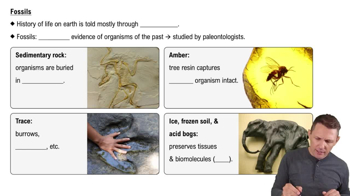
Fossils

Decomposition Rate

Decomposition is the breakdown of organic matter by microorganisms, which is influenced by environmental factors such as temperature, moisture, and oxygen availability. Slow decomposition, often found in environments like swamps or bogs, is favorable for fossilization as it allows more time for mineralization before the remains are completely decomposed.
Recommended video:
Guided course
07:08
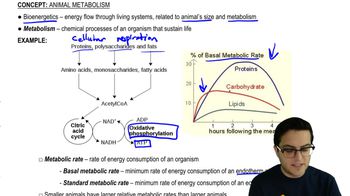
Metabolic Rate

Oxygen Availability

Oxygen plays a significant role in the decomposition process. Environments with low oxygen levels, such as waterlogged areas, slow down the activity of aerobic decomposers, thereby reducing the rate of decomposition. This condition is beneficial for fossilization as it helps preserve the remains long enough for mineralization to occur.
Recommended video:
Guided course
07:27
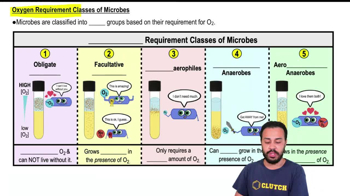
Oxygen Requirement Classes of Microbes
Related Practice
Textbook Question

Which of the following is an example of homoplasy?

a. Hair in humans and fur in mice

b. Astragalus ankle bones in hippos and deer

c. Hox genes in humans and flies

d. Streamlined bodies in dolphins and ichthyosaurs

1093
views
Textbook Question

What important assumption does parsimony make when assessing which phylogenetic tree is most accurate? Why was parsimony misleading in the case of the astragalus during the evolution of artiodactyls?

962
views
Textbook Question

You can use a 'one-snip test' to identify monophyletic groups—meaning that if you 'cut' any branch on a tree, everything that 'falls off' is a monophyletic group. Why is this valid?

2176
views
Textbook Question

Use the fossil evidence shown in Figure 25.6 to determine whether flight evolved earlier in insects or in birds. Is flight an example of homology or convergent evolution? Explain.

706
views
Textbook Question

The vast majority of animals that ever existed are now extinct, but Tereza Jezkova and John Wiens wondered which variables were most important in driving the diversification of species that exist today. Why are there so many species in some phyla, such as Cnidaria, but so few in others, such as Ctenophora? Based on your reading of this chapter, propose at least five traits that you think might have been most important in triggering diversification within phyla (examples: origin of hearing, origin of internal fertilization).

753
views
Textbook Question

The vast majority of animals that ever existed are now extinct, but Tereza Jezkova and John Wiens wondered which variables were most important in driving the diversification of species that exist today. Why are there so many species in some phyla, such as Cnidaria (see photo), but so few in others, such as Ctenophora? Jezkova and Wiens used a type of graph called a linear regression to find correlations between variables such as the proportion of species per phylum with legs (on the y-axis) and the diversification rate per phylum (on the x-axis). Sketch a graph to show what a strong positive correlation between these two variables would look like and what the absence of a correlation would look like.

639
views