Pearson+ LogoPearson+ Logo
Ch.3 - Protein Structure and Function
Freeman - Biological Science 7th Edition
Freeman7th EditionBiological ScienceISBN: 9783584863285Not the one you use?Change textbook
Chapter 3, Problem 10

Make a concept map that relates the four levels of protein structure and shows how they can contribute to the formation of hemoglobin. Your map should include the following boxed terms: Primary structure, Secondary structure, Tertiary structure, Quaternary structure, Amino acid sequence, R-groups, αα-helices, and ββ-pleated sheets.

Verified step by step guidance
1
Start by defining the primary structure of proteins, which is the linear sequence of amino acids. This sequence is determined by the genetic code and is crucial for the protein's final shape and function.
Next, illustrate the secondary structure, which includes αα-helices and ββ-pleated sheets. These structures are formed by hydrogen bonds between the backbone atoms in the polypeptide chain.
Then, describe the tertiary structure, which is the overall three-dimensional shape of a single polypeptide chain. This structure is stabilized by interactions between R-groups, such as hydrogen bonds, ionic bonds, and disulfide bridges.
Explain the quaternary structure, which involves the assembly of multiple polypeptide chains into a functional protein complex. In the case of hemoglobin, it consists of four subunits, each with its own tertiary structure.
Finally, connect these structures to hemoglobin by showing how the specific amino acid sequence (primary structure) leads to the formation of αα-helices and ββ-pleated sheets (secondary structure), which fold into a specific three-dimensional shape (tertiary structure) and assemble into a multi-subunit complex (quaternary structure) to function effectively in oxygen transport.

Verified video answer for a similar problem:

This video solution was recommended by our tutors as helpful for the problem above.
Video duration:
1m
Was this helpful?

Key Concepts

Here are the essential concepts you must grasp in order to answer the question correctly.

Protein Structure Levels

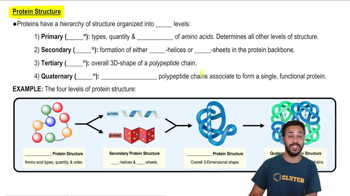
Proteins have four levels of structure: primary, secondary, tertiary, and quaternary. The primary structure is the amino acid sequence, secondary involves α-helices and β-pleated sheets, tertiary is the 3D folding due to R-group interactions, and quaternary is the assembly of multiple polypeptides. Each level contributes to the protein's final shape and function.
Recommended video:
Guided course
08:02
Protein Structure

Amino Acid Sequence

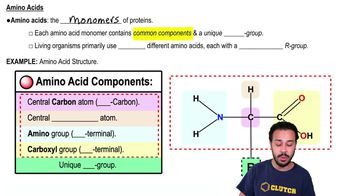
The amino acid sequence is the linear order of amino acids in a protein, determined by the genetic code. This sequence dictates the protein's primary structure and influences higher-level structures by determining how the protein will fold and interact with other molecules, crucial for hemoglobin's function.
Recommended video:

R-groups and Protein Folding

R-groups are the side chains of amino acids that vary in size, charge, and hydrophobicity. They play a critical role in protein folding, affecting tertiary structure by forming bonds and interactions like hydrogen bonds, ionic bonds, and hydrophobic interactions. These interactions are essential for the stability and functionality of proteins like hemoglobin.
Recommended video:
Guided course
04:08
r/K Selection