Pearson+ LogoPearson+ Logo
Ch. 32 - Deuterostome Animals
Freeman - Biological Science 7th Edition
Freeman7th EditionBiological ScienceISBN: 9783584863285Not the one you use?Change textbook
Chapter 32, Problem 2

What trait(s) characterize the vertebrates?a. vertebrae and a craniumb. jaws and a spinal cordc. bony endoskeletond. notochord and post-anal tail

Verified step by step guidance
1
Identify the key traits that are unique to vertebrates. Vertebrates are a subphylum under the phylum Chordata, and they possess certain distinguishing characteristics.
Consider the presence of a vertebrae and a cranium. The vertebrae is a series of bones that make up the vertebral column or spine, providing structural support and protecting the spinal cord. The cranium is a skull that houses and protects the brain.
Evaluate the options that include traits not exclusive to vertebrates but to all chordates, such as the notochord and the post-anal tail, which are present in all chordate embryos.
Analyze the options that mention structures like jaws and a spinal cord. While important, these are either developments seen in specific groups of vertebrates or are characteristic of all chordates (spinal cord).
Conclude by selecting the option that lists traits essential and unique to all vertebrates, which are fundamental for their classification within the animal kingdom.

Verified video answer for a similar problem:

This video solution was recommended by our tutors as helpful for the problem above.
Video duration:
46s
Was this helpful?

Key Concepts

Here are the essential concepts you must grasp in order to answer the question correctly.

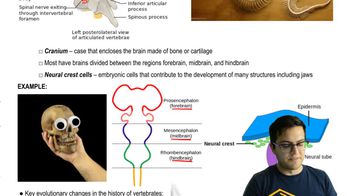
Vertebrae and Cranium

Vertebrates are characterized by the presence of a vertebral column (spine) and a cranium (skull). The vertebrae protect the spinal cord and provide structural support, while the cranium encases the brain, allowing for complex nervous system development. These features distinguish vertebrates from invertebrates, which lack such structures.
Recommended video:

Jaws and Spinal Cord

The evolution of jaws is a significant trait in vertebrates, allowing for more efficient feeding and predation. Additionally, the spinal cord, which runs through the vertebral column, is crucial for transmitting signals between the brain and the rest of the body, facilitating movement and coordination. Together, these traits enhance the adaptability and survival of vertebrate species.
Recommended video:

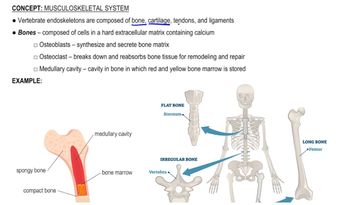
Bony Endoskeleton

Many vertebrates possess a bony endoskeleton, which provides internal support and protection for vital organs. This skeletal structure allows for greater body size and complexity compared to organisms with exoskeletons or no skeletons. The endoskeleton also plays a role in movement and muscle attachment, contributing to the overall functionality and versatility of vertebrates.
Recommended video: