Pearson+ LogoPearson+ Logo
Ch.4 - Nucleic Acids and the RNA World
Freeman - Biological Science 7th Edition
Freeman7th EditionBiological ScienceISBN: 9783584863285Not the one you use?Change textbook
Chapter 4, Problem 10

In the field of nanotechnology, DNA is used like Velcro to assemble tiny particles into structures that are < 0.0001 mm in size. Draw a model to illustrate how two particles (a circle and a square) could be brought together by linking them to short single-stranded DNA molecules. If the DNA sequence linked to the circle is GGATC, then provide the sequence linked to the square and identify the 5′ and 3′ ends of each strand.

Verified step by step guidance
1
Identify the complementary DNA sequence to the one linked to the circle (GGATC). Since DNA pairs are complementary (A pairs with T, and G pairs with C), the sequence linked to the square should be CCTAG.
Determine the 5′ and 3′ ends of each DNA strand. The sequence linked to the circle, GGATC, should be read from the 5′ to 3′ end as provided. Therefore, the complementary sequence linked to the square, CCTAG, should also be aligned from 5′ to 3′ to ensure proper base pairing.
Draw a circle and label it with the DNA sequence GGATC, marking the 5′ end at the beginning of the sequence and the 3′ end at the end of the sequence.
Draw a square and label it with the complementary DNA sequence CCTAG, marking the 5′ end at the beginning of the sequence and the 3′ end at the end of the sequence.
Illustrate DNA hybridization by drawing lines or bridges between the circle and the square, showing base pairing between G and C, and between A and T, to visually represent how the DNA sequences hold the two shapes together.

Verified video answer for a similar problem:

This video solution was recommended by our tutors as helpful for the problem above.
Video duration:
2m
Was this helpful?

Key Concepts

Here are the essential concepts you must grasp in order to answer the question correctly.

DNA Structure and Function

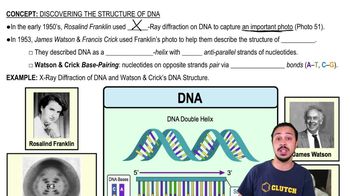
DNA is composed of two strands forming a double helix, with each strand made up of nucleotides. Each nucleotide consists of a sugar, a phosphate group, and a nitrogenous base (adenine, thymine, cytosine, or guanine). The sequence of these bases encodes genetic information and determines how DNA can interact with other molecules, such as through complementary base pairing, which is crucial for the assembly of particles in nanotechnology.
Recommended video:
Guided course
04:41
Discovering the Structure of DNA

Complementary Base Pairing

Complementary base pairing refers to the specific pairing of nitrogenous bases in DNA: adenine pairs with thymine (A-T) and cytosine pairs with guanine (C-G). This principle is fundamental in DNA interactions, allowing single-stranded DNA molecules to bind to their complementary sequences. In the context of the question, the DNA sequence linked to the square must be complementary to the sequence linked to the circle to facilitate their assembly.
Recommended video:

5' and 3' Ends of DNA Strands

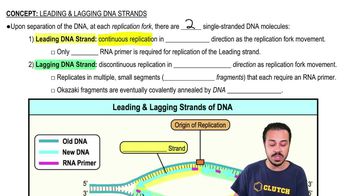
DNA strands have directionality, indicated by the 5' (five-prime) and 3' (three-prime) ends. The 5' end has a phosphate group attached, while the 3' end has a hydroxyl group. This orientation is crucial for DNA replication and interactions, as enzymes and other molecules recognize these ends. In the question, identifying the 5' and 3' ends of the DNA sequences linked to the circle and square is essential for understanding how they will interact.
Recommended video:
Guided course
05:15
Leading & Lagging DNA Strands