Pearson+ LogoPearson+ Logo
Ch. 45 - Animal Movement
Freeman - Biological Science 7th Edition
Freeman7th EditionBiological ScienceISBN: 9783584863285Not the one you use?Change textbook
Chapter 45, Problem 11a

Distance runner Paula Radcliffe has won dozens of long-distance races and held the women's world record for the marathon since 2003. Scientists, trainers, and athletes alike have wondered about the extent to which muscle structure and function contribute to success in athletes such as Radcliffe.
What makes elite distance runners so good?
Are their muscles somehow different from those of less successful athletes and non-athletes?
Compare and contrast the structure and function of the three types of skeletal muscle fibers.

Verified step by step guidance
1
Begin by identifying the three types of skeletal muscle fibers: Type I (slow-twitch), Type IIa (fast-twitch oxidative), and Type IIb (fast-twitch glycolytic). Each type has distinct characteristics that contribute to their function.
Type I fibers are known for their endurance capabilities. They have a high density of mitochondria, which allows them to efficiently use oxygen for aerobic respiration. This makes them ideal for long-duration activities like marathon running. They are also rich in myoglobin, giving them a red color.
Type IIa fibers are intermediate fibers that possess characteristics of both Type I and Type IIb fibers. They can generate more force than Type I fibers and are capable of both aerobic and anaerobic metabolism. This makes them versatile for activities that require both endurance and power.
Type IIb fibers are designed for short bursts of power and speed. They have fewer mitochondria and rely primarily on anaerobic glycolysis for energy production, which allows them to generate quick and powerful contractions. However, they fatigue quickly compared to Type I fibers.
Compare the functional implications: Type I fibers are crucial for endurance athletes like Paula Radcliffe, as they support sustained activity over long periods. Type IIa fibers provide a balance of endurance and power, while Type IIb fibers are more suited for activities requiring short, explosive movements. Understanding these differences helps explain why elite distance runners excel in their sport.

Verified video answer for a similar problem:

This video solution was recommended by our tutors as helpful for the problem above.
Video duration:
3m
Was this helpful?

Key Concepts

Here are the essential concepts you must grasp in order to answer the question correctly.

Skeletal Muscle Fiber Types

Skeletal muscles are composed of three main types of fibers: Type I (slow-twitch), Type IIa (fast-twitch oxidative), and Type IIb (fast-twitch glycolytic). Type I fibers are endurance-oriented, relying on aerobic metabolism, while Type II fibers are suited for short bursts of power, with Type IIa being more fatigue-resistant than Type IIb. Understanding these differences is crucial for analyzing muscle performance in athletes.
Recommended video:
Guided course
02:40
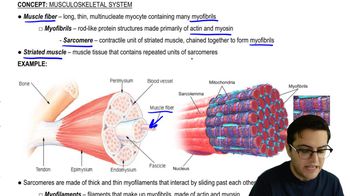
Muscle Fibers and Sarcomeres

Muscle Fiber Structure

The structure of muscle fibers varies among the three types, influencing their function. Type I fibers have a high density of mitochondria and capillaries, supporting sustained aerobic activity. Type IIa fibers also have a significant mitochondrial presence but are more adaptable to anaerobic conditions. Type IIb fibers have fewer mitochondria and rely heavily on anaerobic metabolism, making them ideal for explosive movements.
Recommended video:
Guided course
02:40
Muscle Fibers and Sarcomeres

Muscle Fiber Function

Functionally, muscle fibers differ in contraction speed and endurance. Type I fibers contract slowly but sustain activity over long periods, ideal for endurance sports like marathon running. Type IIa fibers offer a balance between speed and endurance, suitable for middle-distance events. Type IIb fibers contract rapidly and powerfully but fatigue quickly, making them less suited for endurance but perfect for sprinting and high-intensity activities.
Recommended video:
Guided course
02:40
Muscle Fibers and Sarcomeres
Related Practice
Textbook Question

Which of the following is critical to the function of most exoskeletons, endoskeletons, and hydrostatic skeletons?

a. Muscles interact with the skeleton in antagonistic groups.

b. Muscles attach to each of these types of skeletons via tendons.

c. Muscles extend joints by pushing skeletal elements.

d. Segments of the body or limbs are extended when paired muscles relax in unison.

666
views
Textbook Question

How did data on sarcomere structure inspire the sliding-filament model of muscle contraction?

Explain why the observation that muscle cells contain many mitochondria and extensive smooth endoplasmic reticulum turned out to be logical once the molecular mechanism of muscular contraction was understood.

682
views
Textbook Question

Rigor mortis is the stiffening of a body after death that occurs when myosin binds to actin but cannot unbind. What prevents myosin from unbinding?

1776
views
Textbook Question

Distance runner Paula Radcliffe has won dozens of long-distance races and held the women's world record for the marathon since 2003. Scientists, trainers, and athletes alike have wondered about the extent to which muscle structure and function contribute to success in athletes such as Radcliffe.

What makes elite distance runners so good?

Are their muscles somehow different from those of less successful athletes and non-athletes?

Predict who would likely have a greater proportion of fast glycolytic fibers in their gastrocnemius (calf) muscle—an elite distance runner or an elite sprinter. Explain.

886
views
Textbook Question

Distance runner Paula Radcliffe has won dozens of long-distance races and held the women's world record for the marathon since 2003. Scientists, trainers, and athletes alike have wondered about the extent to which muscle structure and function contribute to success in athletes such as Radcliffe.

What makes elite distance runners so good? Are their muscles somehow different from those of less successful athletes and non-athletes?

Predict the effect of training for a marathon on the number of muscle cells in the gastrocnemius. Explain.

1032
views
Textbook Question

Distance runner Paula Radcliffe has won dozens of long-distance races and held the women's world record for the marathon since 2003. Scientists, trainers, and athletes alike have wondered about the extent to which muscle structure and function contribute to success in athletes such as Radcliffe.

What makes elite distance runners so good?

Are their muscles somehow different from those of less successful athletes and non-athletes?

To discover the relationship between muscle-fiber types and performance, researchers obtained tiny biopsies of the gastrocnemius of 14 elite distance runners, 18 trained but non-elite distance runners, and 19 untrained subjects. They categorized the fiber types as slow or fast. (At the time of the study, intermediate fibers had not been identified as a third type.) Some of their data are shown here (* means). What conclusions can you draw from these data?

1018
views