Pearson+ LogoPearson+ Logo
Ch. 46 - Chemical Signals in Animals
Freeman - Biological Science 7th Edition
Freeman7th EditionBiological ScienceISBN: 9783584863285Not the one you use?Change textbook
Chapter 46, Problem 3

Which of the following assertions regarding hormones is correct? Select True or False for each statement.
T/F Growth and metamorphosis are controlled by hormones.
T/F Cortisol stimulates the production of ACTH.
T/F Hormones produced by the hypothalamus are considered neurohormones.
T/F Hormonal changes during puberty and pregnancy are forms of endocrine disruption.

Verified step by step guidance
1
Understand that hormones are chemical messengers that regulate various physiological processes in the body, including growth, metabolism, and reproduction.
Consider the role of hormones in growth and metamorphosis. Hormones like growth hormone and thyroid hormones are crucial for these processes, so evaluate the truth of the statement regarding their control over growth and metamorphosis.
Examine the relationship between cortisol and ACTH (Adrenocorticotropic hormone). Cortisol is produced in response to ACTH, not the other way around, so assess the accuracy of the statement about cortisol stimulating ACTH production.
Recognize that hormones produced by the hypothalamus, such as releasing and inhibiting hormones, are indeed considered neurohormones because they are produced by neurosecretory cells.
Understand that hormonal changes during puberty and pregnancy are natural processes and not typically considered endocrine disruption, which refers to external factors interfering with hormone function.

Verified video answer for a similar problem:

This video solution was recommended by our tutors as helpful for the problem above.
Video duration:
1m
Was this helpful?

Key Concepts

Here are the essential concepts you must grasp in order to answer the question correctly.

Hormonal Control of Growth and Metamorphosis

Hormones play a crucial role in regulating growth and metamorphosis in organisms. For example, in insects, ecdysone and juvenile hormone control the process of molting and metamorphosis. In vertebrates, growth hormone and thyroid hormones are essential for normal growth and development, influencing processes like cell division and differentiation.
Recommended video:
Guided course
03:20
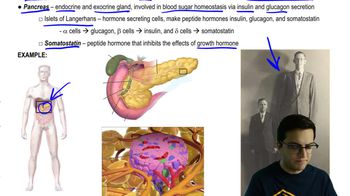
Growth Hormone and Pancreas

Hypothalamic Neurohormones

Neurohormones are hormones produced by neurosecretory cells, such as those in the hypothalamus. These hormones, like oxytocin and vasopressin, are released into the bloodstream and act on distant target organs. The hypothalamus also produces releasing and inhibiting hormones that regulate the anterior pituitary gland's secretion of various hormones.
Recommended video:
Guided course
03:34
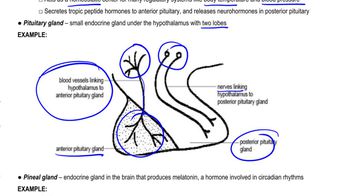
Hypothalamus and Pituitary

Endocrine Disruption

Endocrine disruption refers to changes in the normal function of the endocrine system, often due to external factors like chemicals. However, natural hormonal changes during life stages such as puberty and pregnancy are not considered disruptions but rather normal physiological processes. These changes are essential for development and reproductive functions.
Recommended video:
Guided course
05:55
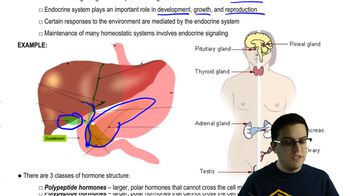
Endocrine System