Pearson+ LogoPearson+ Logo
Ch. 50 - Behavioral Ecology
Freeman - Biological Science 7th Edition
Freeman7th EditionBiological ScienceISBN: 9783584863285Not the one you use?Change textbook
Chapter 50, Problem 8

Hamilton's rule states that an altruistic allele could spread in a population if Br > C, where B represents the fitness benefit to the recipient, r is the coefficient of relatedness between altruist and recipient, and C represents the fitness cost to the altruist. If r = 0.5 between the altruist and the recipient, what would the ratio of costs to benefits have to be for the altruistic allele to spread?
a. C/ B > 0.5
b. C/ B > 0
c. C/ B < 0.5
d. C/ B < 0

Verified step by step guidance
1
Understand Hamilton's rule: Br > C, where B is the benefit to the recipient, r is the coefficient of relatedness, and C is the cost to the altruist.
Substitute the given value of r into the inequality: 0.5B > C.
Rearrange the inequality to express the cost-to-benefit ratio: C/B < 0.5.
Interpret the inequality: For the altruistic allele to spread, the cost-to-benefit ratio (C/B) must be less than 0.5.
Compare the options provided with the derived inequality to determine the correct answer.

Verified video answer for a similar problem:

This video solution was recommended by our tutors as helpful for the problem above.
Video duration:
2m
Was this helpful?

Key Concepts

Here are the essential concepts you must grasp in order to answer the question correctly.

Hamilton's Rule

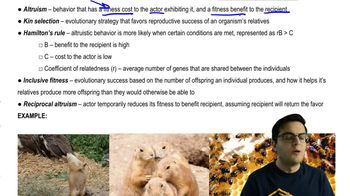
Hamilton's Rule is a principle in evolutionary biology that predicts when an altruistic behavior will spread in a population. It states that an altruistic allele can increase in frequency if the genetic relatedness (r) between the altruist and the recipient, multiplied by the benefit to the recipient (B), is greater than the cost to the altruist (C). Mathematically, this is expressed as Br > C.
Recommended video:
Guided course
04:33
Chargaff's Rules

Coefficient of Relatedness (r)

The coefficient of relatedness (r) is a measure of genetic similarity between two individuals. It quantifies the probability that a gene in one individual is identical by descent to a gene in another individual. For example, siblings have an r value of 0.5, meaning they share 50% of their genes, which is crucial in determining the likelihood of altruistic behavior according to Hamilton's Rule.
Recommended video:
Guided course
04:08
r/K Selection

Cost-Benefit Ratio in Altruism

The cost-benefit ratio in altruism refers to the relationship between the fitness cost to the altruist (C) and the fitness benefit to the recipient (B). For an altruistic allele to spread, the ratio C/B must be less than the coefficient of relatedness (r). In the given question, with r = 0.5, the condition for the allele to spread is C/B < 0.5, making option c the correct answer.
Recommended video:
Guided course
07:15
Migration and Altruism