<Image>
Burmese pythons (Python molurus bivittatus) are constricting snakes that can reach enormous sizes (up to 7 meters in length). They are native to Southeast Asia but were released into southern Florida from the pet trade. Many other snakes occur naturally in this area. Are the introduced pythons a problem?
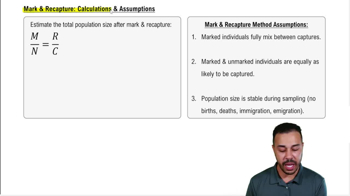
The data in the graph show the number of pythons that were encountered, not the total number of pythons in the population. Design a mark–recapture experiment to estimate the total population size of pythons, and list at least two assumptions you would be making in your experiment.

Verified step by step guidance
Verified video answer for a similar problem:
Key Concepts
Mark-Recapture Method
Assumptions in Mark-Recapture
Ecological Impact of Invasive Species
<Image>
Burmese pythons (Python molurus bivittatus) are constricting snakes that can reach enormous sizes (up to 7 meters in length). They are native to Southeast Asia but were released into southern Florida from the pet trade. Many other snakes occur naturally in this area. Are the introduced pythons a problem?
Burmese pythons were first found in the wetlands of Everglades National Park in the 1980s, but only rarely. The accompanying graph shows what happened next. Most of the data are derived from chance encounters of pythons on roads (pythons are notoriously difficult to find). How would you describe the type of population growth in pythons from 2000 to 2008?
a. Logistic
b. Exponential
c. Linear
d. Logarithmic
<Image>
Burmese pythons (Python molurus bivittatus) are constricting snakes that can reach enormous sizes (up to 7 meters in length). They are native to Southeast Asia but were released into southern Florida from the pet trade. Many other snakes occur naturally in this area. Are the introduced pythons a problem?
Researchers hypothesize that the severe winter of 2010 caused the decline in the number of pythons encountered that year. Is cold weather typically a density-dependent factor or a density-independent factor? Explain the difference.
<Image>
Burmese pythons (Python molurus bivittatus) are constricting snakes that can reach enormous sizes (up to 7 meters in length). They are native to Southeast Asia but were released into southern Florida from the pet trade. Many other snakes occur naturally in this area. Are the introduced pythons a problem?
A life table would help researchers make predictions about python population growth. If you were to track a cohort of pythons over time to construct a detailed life table, what kind of data would you want to collect?
<Image>
Burmese pythons (Python molurus bivittatus) are constricting snakes that can reach enormous sizes (up to 7 meters in length). They are native to Southeast Asia but were released into southern Florida from the pet trade. Many other snakes occur naturally in this area. Are the introduced pythons a problem?
Pythons are generalist predators, consuming a wide variety of prey including birds, mammals ranging from rodents to deer, and alligators. A road survey showed a 99 percent decrease in the frequency of raccoon and opossum observations within python areas from 2003 to 2011. Rabbits and foxes have also disappeared from the area. Do you think food availability limits, or could limit, the carrying capacity of Burmese pythons in the Everglades?
<Image>
Burmese pythons (Python molurus bivittatus) are constricting snakes that can reach enormous sizes (up to 7 meters in length). They are native to Southeast Asia but were released into southern Florida from the pet trade. Many other snakes occur naturally in this area. Are the introduced pythons a problem?
The range of Burmese pythons in Florida is expanding rapidly. List at least one abiotic factor and one biotic factor that might limit the range of pythons.