Skip to main content
Statistics for Business
My Course
Learn
Exam Prep
AI Tutor
Study Guides
Flashcards
Explore
Try the app
My Course
Learn
Exam Prep
AI Tutor
Study Guides
Flashcards
Explore
Try the app
Back
Two Means - Unknown, Equal Variances Hypothesis Test - Excel quiz
You can tap to flip the card.
When should you use the pooled t test for comparing two means?
You can tap to flip the card.
👆
When should you use the pooled t test for comparing two means?
Use the pooled t test when the variances of the two populations are assumed equal but unknown.
Track progress
Control buttons has been changed to "navigation" mode.
1/15
Related flashcards
Related practice
Recommended videos
Two Means - Unknown, Equal Variances Hypothesis Test - Excel definitions
Two Means - Unknown, Equal Variances Hypothesis Test - Excel
15 Terms
Two Means - Known Variance
10. Hypothesis Testing for Two Samples
5 problems
Topic
Justin
10. Hypothesis Testing for Two Samples - Part 1 of 2
3 topics
15 problems
Chapter
Ally
10. Hypothesis Testing for Two Samples - Part 2 of 2
3 topics
8 problems
Chapter
Justin
Guided course
05:54
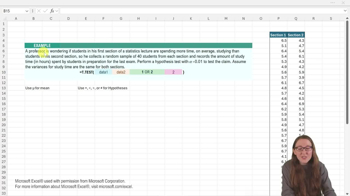
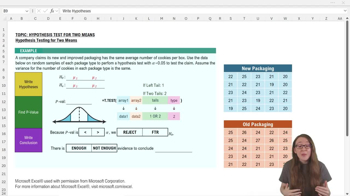
Two Means Unknown, Equal Variances Hypothesis Test - Excel
86
views
Guided course
04:00
Two Means Unknown, Equal Variances Hypothesis Test - Excel Example 1
69
views
1
rank
Terms in this set (15)
Hide definitions
When should you use the pooled t test for comparing two means?
Use the pooled t test when the variances of the two populations are assumed equal but unknown.
What is the null hypothesis in a pooled t test for two means?
The null hypothesis is that the two population means are equal (μ1 = μ2).
What is the alternative hypothesis in a pooled t test when testing for any difference?
The alternative hypothesis is that the two population means are not equal (μ1 ≠ μ2).
Which Excel function is used to perform a pooled t test?
The T.TEST function in Excel is used to perform a pooled t test.
What value should you enter for the 'type' argument in Excel’s T.TEST function to run a pooled t test?
You should enter 2 for the 'type' argument to specify a pooled t test.
What does a p-value less than alpha indicate in a pooled t test?
A p-value less than alpha means you reject the null hypothesis, indicating significant evidence that the means differ.
If your alternative hypothesis is 'not equal,' what value should you use for the tails argument in Excel’s T.TEST?
You should use 2 for the tails argument to indicate a two-tailed test.
What is the significance level (alpha) commonly used in hypothesis testing?
A common significance level is 0.05.
What does it mean to 'reject the null hypothesis' in the context of a pooled t test?
It means there is enough evidence to conclude that the two population means are not equal.
What is the first step in conducting a pooled t test?
The first step is to state the null and alternative hypotheses.
How does Excel’s T.TEST function help in hypothesis testing?
It calculates the p-value directly from the data, allowing you to compare it to alpha.
What does the assumption of equal variances mean for the pooled t test?
It means you assume both populations have the same variance, even though you don't know its value.
What should you do if the p-value is greater than alpha in a pooled t test?
You fail to reject the null hypothesis, meaning there is not enough evidence to say the means differ.
In the context of the example, what does rejecting the null hypothesis imply about the packaging?
It implies that the new and old packaging do not have the same average number of cookies.
Why is the pooled t test important in business analytics?
It allows analysts to test for differences between group means when variances are assumed equal, supporting data-driven decisions.
 BackBack

 05:54
05:54