Skip to main content
Calculus
My Course
Learn
Exam Prep
AI Tutor
Study Guides
Textbook Solutions
Flashcards
Explore
Try the app
My Course
Learn
Exam Prep
AI Tutor
Study Guides
Textbook Solutions
Flashcards
Explore
Try the app
Back
Basic Graphing of the Derivative definitions
You can tap to flip the card.
Derivative
You can tap to flip the card.
👆
Derivative
Numerical value representing the slope of a tangent line to a function at a specific point.
Track progress
Control buttons has been changed to "navigation" mode.
1/15
Related flashcards
Related practice
Recommended videos
Basic Graphing of the Derivative quiz
Basic Graphing of the Derivative
15 Terms
Basic Graphing of the Derivative
2. Intro to Derivatives
3 problems
Topic
Ally
Differentiability
2. Intro to Derivatives
3 problems
Topic
David-Paige
2. Intro to Derivatives
4 topics
7 problems
Chapter
Jonathan
Guided course
04:24
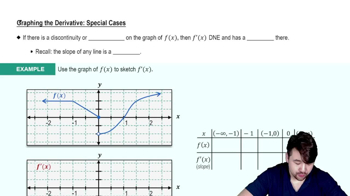
Graphing The Derivative - Special Cases
1663
views
31
rank
Guided course
06:15
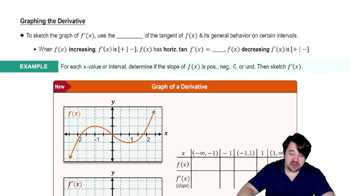
Graphing The Derivative
2500
views
47
rank
Guided course
03:29
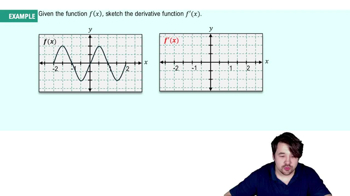
Graphing The Derivative Example 1
1545
views
33
rank
Terms in this set (15)
Hide definitions
Derivative
Numerical value representing the slope of a tangent line to a function at a specific point.
Tangent Line
Straight line that just touches a curve at a point, matching the curve's instantaneous direction.
Slope
Measure of steepness or incline of a line, indicating how much the function rises or falls.
Interval
Continuous range of x-values over which a function's behavior is analyzed for changes in slope.
Peak
Highest point on a graph where the tangent line is flat and the derivative equals zero.
Valley
Lowest point on a graph where the tangent line is flat and the derivative equals zero.
Discontinuity
Point on a graph where the function jumps or breaks, causing the derivative to not exist.
Sharp Corner
Point where the graph changes direction abruptly, resulting in an undefined derivative.
Constant Function
Graph segment where the output remains unchanged, leading to a zero derivative throughout.
Zero Slope
Situation where the tangent line is horizontal, indicating no increase or decrease in the function.
Positive Slope
Condition where the tangent line rises as x increases, showing the function is increasing.
Negative Slope
Condition where the tangent line falls as x increases, showing the function is decreasing.
X Axis
Horizontal reference line on a graph where a zero derivative is represented.
Jump
Sudden change in the graph's value, often leading to a non-existent derivative at that point.
Output
Value produced by a function for a given input, visualized as the y-coordinate on a graph.
 BackBack
 04:24
04:24