Skip to main content
Calculus
My Course
Learn
Exam Prep
AI Tutor
Study Guides
Textbook Solutions
Flashcards
Explore
Try the app
My Course
Learn
Exam Prep
AI Tutor
Study Guides
Textbook Solutions
Flashcards
Explore
Try the app
Back
Basic Rules of Differentiation quiz
2 students found this helpful
You can tap to flip the card.
What is the derivative of any constant function?
You can tap to flip the card.
👆
What is the derivative of any constant function?
The derivative of any constant function is always 0.
Track progress
Control buttons has been changed to "navigation" mode.
1/15
Related flashcards
Related practice
Recommended videos
Basic Rules of Differentiation definitions
Basic Rules of Differentiation
15 Terms
Basic Rules of Differentiation
3. Techniques of Differentiation
4 problems
Topic
Ernest
Higher Order Derivatives
3. Techniques of Differentiation
3 problems
Topic
Justin
3. Techniques of Differentiation
5 topics
10 problems
Chapter
Ally
04:09
The Power Rule: Negative & Rational Exponents
2246
views
57
rank
03:37
The Power Rule: Negative & Rational Exponents Example 1
1920
views
54
rank
1
comments
04:02
The Power Rule
2191
views
65
rank
Terms in this set (15)
Hide definitions
What is the derivative of any constant function?
The derivative of any constant function is always 0.
What is the derivative of the function f(x) = x?
The derivative of f(x) = x is always 1.
State the sum and difference rule for derivatives.
The derivative of a sum or difference is the sum or difference of the derivatives.
How does the constant multiple rule work when differentiating?
You can pull the constant out front and multiply it by the derivative of the function.
What does the power rule state for differentiating x^n?
The derivative of x^n is n times x to the (n-1) power.
Can the power rule be used for negative exponents?
Yes, the power rule works for any real exponent, including negative exponents.
How do you rewrite 1/x to use the power rule for differentiation?
Rewrite 1/x as x^(-1) before applying the power rule.
What is the derivative of x^6 using the power rule?
The derivative is 6x^5.
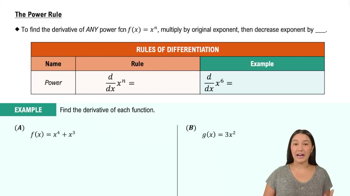
How do you differentiate f(x) = x^4 + x^3?
Differentiate each term separately to get 4x^3 + 3x^2.
What is the derivative of g(x) = 3x^2?
The derivative is 6x.
What is the derivative of x^(-3)?
The derivative is -3x^(-4), or equivalently, -3/x^4.
How do you find the derivative of x^(3/2)?
The derivative is (3/2)x^(1/2).
What is the derivative of f(x) = 1/x?
The derivative is -1/x^2.
How do you differentiate the cube root of x?
Rewrite as x^(1/3) and the derivative is (1/3)x^(-2/3).
Why is the derivative of a constant function always zero?
Because the slope of the tangent line to a constant function is always zero.
 BackBack

 04:09
04:09