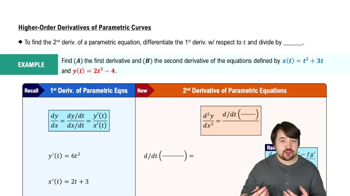
A representation where both horizontal and vertical coordinates are expressed as functions of a third variable, typically t.
Parameter
An independent variable, often t, used to define both horizontal and vertical positions along a curve.
Prime Notation
A shorthand indicating differentiation with respect to the parameter, such as x′(t) or y′(t).
First Derivative
A ratio of the rate of change of the vertical coordinate to the rate of change of the horizontal coordinate, both with respect to the parameter.
Second Derivative
A measure of how the slope of a curve changes, found by differentiating the first derivative with respect to the parameter and dividing by the horizontal rate of change.
Higher-Order Derivative
A result from repeatedly differentiating the previous derivative with respect to the parameter and dividing by the horizontal rate of change.
Tangent Line
A straight line that touches a curve at a single point and has the same slope as the curve at that point.
Point-Slope Form
An equation format for a line using a known point and the slope, often used to write the equation of a tangent.
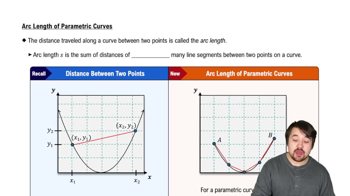
Arc Length
The total distance along a curve between two points, calculated by integrating the square root of the sum of squared rates of change.
Interval
A range of parameter values, typically denoted [a, b], over which a curve or calculation is considered.
Quotient Rule
A differentiation technique for ratios, involving the derivative of the numerator and denominator.
Distance Formula
A method for finding the straight-line distance between two points, foundational for arc length calculations.
Pythagorean Identity
A trigonometric relationship stating that the sum of the squares of sine and cosine equals one, often used to simplify arc length integrals.
Rational Function
An expression formed by dividing one polynomial by another, commonly appearing in derivatives of parametric curves.
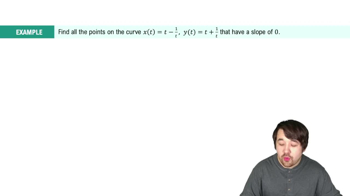
Slope
A measure of steepness, given by the value of the first derivative at a specific parameter value.
 Back
Back
 06:38
06:38