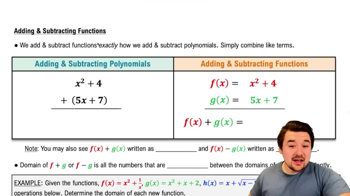
Add the corresponding terms of f(x) and g(x) together, just like adding polynomials, and combine like terms.
What is the domain of the sum or difference of two functions?
The domain is the set of all x-values common to the domains of both functions.
How do you subtract one function from another, such as g(x) - h(x)?
Distribute the negative sign to each term in h(x), then combine like terms with g(x).
What domain restriction occurs when a function has a denominator with x?
x cannot be equal to any value that makes the denominator zero, since division by zero is undefined.
How do you multiply two functions f(x) and g(x)?
Multiply the expressions for f(x) and g(x) together, distributing as needed, and simplify.
What is the domain of the product of two functions?
The domain is the intersection of the domains of the two functions.
What extra domain restriction must you consider when dividing functions?
The denominator function must not be zero, so exclude any x-values that make the denominator zero.
How do you find the domain of f(x)/g(x) if g(x) = x + 2?
Exclude x = -2 from the domain, since it makes the denominator zero.
What is the process for composing two functions, such as f(g(x))?
Evaluate the inside function g(x) first, then substitute its result into the outer function f(x).
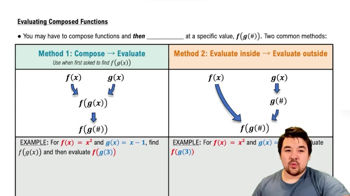
What are the two methods for evaluating a composed function at a number?
You can either find the composition first and then substitute the number, or evaluate the inside function at the number and then plug that result into the outer function.
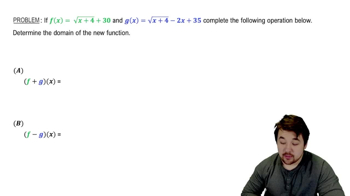
Why must you check for domain restrictions when combining functions with square roots?
The expression inside the square root must be non-negative, so restrict the domain to values that keep it non-negative.
If f(x) = x^2 and g(x) = x - 1, what is f(g(x))?
f(g(x)) = (x - 1)^2, which simplifies to x^2 - 2x + 1.
What is the shortcut method for evaluating f(g(a))?
First evaluate g(a), then substitute that result into f(x) to get f(g(a)).
When does the shortcut method for evaluating composed functions not work?
It does not work if you are specifically asked to find the general form of the composition before evaluating at a number.
Why should you determine domain restrictions before simplifying a function after division?
Because simplification can remove factors from the denominator, but the original restrictions still apply to the domain.
 Back
Back

 4:26
4:26