Skip to main content
Calculus
My Course
Learn
Exam Prep
AI Tutor
Study Guides
Textbook Solutions
Flashcards
Explore
Try the app
My Course
Learn
Exam Prep
AI Tutor
Study Guides
Textbook Solutions
Flashcards
Explore
Try the app
Back
Differentials definitions
You can tap to flip the card.
Derivative
You can tap to flip the card.
👆
Derivative
Slope of the tangent line to a function at a point, representing the rate of change with respect to the independent variable.
Track progress
Control buttons has been changed to "navigation" mode.
1/15
Related flashcards
Related practice
Recommended videos
Differentials quiz #1
Differentials
10 Terms
Differentials
4. Applications of Derivatives
4 problems
Topic
Ernest
Linearization
4. Applications of Derivatives
3 problems
Topic
Jonathan
4. Applications of Derivatives
5 topics
10 problems
Chapter
Justin
Guided course
05:53
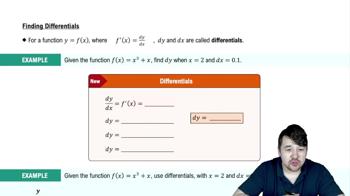
Finding Differentials
1526
views
30
rank
1
comments
Guided course
04:57
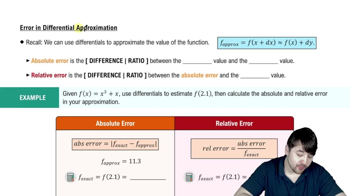
Determining Error and Relative Error
900
views
20
rank
Guided course
04:46
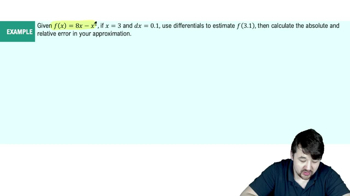
Determining Error and Relative Error Example 1
766
views
21
rank
Terms in this set (15)
Hide definitions
Derivative
Slope of the tangent line to a function at a point, representing the rate of change with respect to the independent variable.
Differential
Small change in a function's output, estimated by multiplying the derivative by a small change in the input.
dx
Infinitesimal change in the independent variable, used to approximate small variations in function values.
dy
Approximate change in the dependent variable, calculated as the derivative times dx for small input changes.
Power Rule
Shortcut for finding the derivative of a term with a variable raised to a power, multiplying by the exponent and reducing it by one.
Tangent Line
Straight line that touches a curve at a single point, sharing the same slope as the curve at that point.
Approximate Value
Estimated result for a function, often found using differentials when exact calculation is difficult.
Exact Value
True result of a function, obtained by direct calculation without estimation or rounding.
Absolute Error
Non-negative difference between the exact value and the approximate value, indicating the size of the estimation mistake.
Relative Error
Ratio of absolute error to the exact value, providing a sense of the error's size compared to the true result.
Percentage Error
Relative error expressed as a percent, showing how far off an approximation is in terms of the exact value.
Delta x
Finite change in the independent variable, often compared to dx for small increments in calculus.
Delta y
Finite change in the dependent variable, closely related to dy for small changes in input.
Slope
Measure of steepness of a line, given by the ratio of vertical change to horizontal change between two points.
Function
Mathematical relationship assigning each input exactly one output, often written as y = f(x).
 BackBack
 05:53
05:53