Skip to main content
Calculus
My Course
Learn
Exam Prep
AI Tutor
Study Guides
Textbook Solutions
Flashcards
Explore
Try the app
My Course
Learn
Exam Prep
AI Tutor
Study Guides
Textbook Solutions
Flashcards
Explore
Try the app
Back
Graphs of Trigonometric Functions definitions
You can tap to flip the card.
Unit Circle
You can tap to flip the card.
👆
Unit Circle
A circle with radius 1, used to determine sine and cosine values based on x and y coordinates.
Track progress
Control buttons has been changed to "navigation" mode.
1/15
Related flashcards
Related practice
Recommended videos
Graphs of Trigonometric Functions quiz
Graphs of Trigonometric Functions
15 Terms
Graphs of Trigonometric Functions
0. Functions
3 problems
Topic
Jonathan
Trigonometric Identities
0. Functions
2 problems
Topic
0. Functions - Part 1 of 2
7 topics
14 problems
Chapter
Patrick
0. Functions - Part 2 of 2
8 topics
12 problems
Chapter
David-Paige
Guided course
5:53
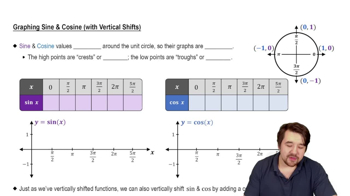
Graph of Sine and Cosine Function
1700
views
32
rank
Guided course
3:15
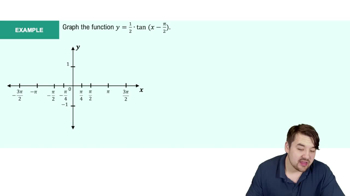
Introduction to Tangent Graph Example 1
888
views
12
rank
1
comments
Guided course
5:37
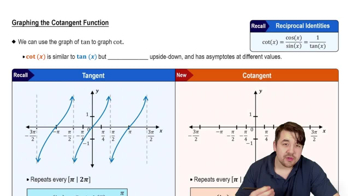
Introduction to Cotangent Graph
973
views
9
rank
Terms in this set (15)
Hide definitions
Unit Circle
A circle with radius 1, used to determine sine and cosine values based on x and y coordinates.
Crest
A highest point on a wave-like graph, representing the maximum output value.
Trough
A lowest point on a wave-like graph, representing the minimum output value.
Vertical Shift
A transformation that moves a graph up or down by adding a constant to the function.
Reciprocal Identity
A relationship where one trigonometric function equals 1 divided by another, such as cosecant and sine.
Asymptote
A vertical line where a graph approaches infinity due to division by zero, indicating undefined values.
Period
The horizontal length required for a trigonometric graph to complete one full cycle and start repeating.
Peak
A point on a graph where the function reaches its highest value within a cycle.
Valley
A point on a graph where the function reaches its lowest value within a cycle.
Transformation
A change applied to a graph, such as shifting or stretching, altering its position or shape.
Secant
A trigonometric function defined as the reciprocal of cosine, with its own distinct graph and asymptotes.
Cosecant
A trigonometric function defined as the reciprocal of sine, featuring vertical asymptotes at sine's zeros.
Tangent
A trigonometric function formed by dividing sine by cosine, with a period of π and vertical asymptotes.
Cotangent
A trigonometric function formed as the reciprocal of tangent, with a period of π and shifted asymptotes.
Wave Pattern
A repeating, oscillating shape seen in sine and cosine graphs, characterized by regular crests and troughs.
 BackBack

 5:53
5:53