Skip to main content
Calculus
My Course
Learn
Exam Prep
AI Tutor
Study Guides
Textbook Solutions
Flashcards
Explore
Try the app
My Course
Learn
Exam Prep
AI Tutor
Study Guides
Textbook Solutions
Flashcards
Explore
Try the app
Back
Graphs of Trigonometric Functions quiz
You can tap to flip the card.
What is the starting value of the sine graph at x = 0, and how does it progress through one period?
You can tap to flip the card.
👆
What is the starting value of the sine graph at x = 0, and how does it progress through one period?
The sine graph starts at 0, reaches 1 at π/2, returns to 0 at π, drops to -1 at 3π/2, and returns to 0 at 2π.
Track progress
Control buttons has been changed to "navigation" mode.
1/15
Related flashcards
Related practice
Recommended videos
Graphs of Trigonometric Functions definitions
Graphs of Trigonometric Functions
15 Terms
Graphs of Trigonometric Functions
0. Functions
3 problems
Topic
Jonathan
Trigonometric Identities
0. Functions
2 problems
Topic
0. Functions - Part 1 of 2
7 topics
14 problems
Chapter
Patrick
0. Functions - Part 2 of 2
8 topics
12 problems
Chapter
David-Paige
Guided course
5:53
Graph of Sine and Cosine Function
1694
views
32
rank
Guided course
3:15
Introduction to Tangent Graph Example 1
886
views
12
rank
1
comments
Guided course
5:37
Introduction to Cotangent Graph
968
views
9
rank
Terms in this set (15)
Hide definitions
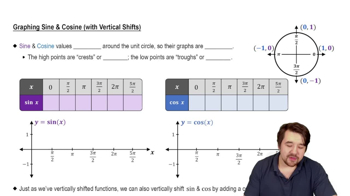
What is the starting value of the sine graph at x = 0, and how does it progress through one period?
The sine graph starts at 0, reaches 1 at π/2, returns to 0 at π, drops to -1 at 3π/2, and returns to 0 at 2π.
How does the cosine graph differ from the sine graph in terms of starting value and progression?
The cosine graph starts at 1 when x = 0, drops to 0 at π/2, reaches -1 at π, returns to 0 at 3π/2, and back to 1 at 2π.
What are the terms for the highest and lowest points on a sine or cosine graph?
The highest points are called peaks or crests, and the lowest points are called valleys or troughs.
How does adding a positive constant k to a sine or cosine function affect its graph?
Adding a positive constant shifts the entire graph vertically upward by k units without changing its shape.
What is the reciprocal of the sine function, and what is a key feature of its graph?
The reciprocal of sine is cosecant (csc), and its graph has vertical asymptotes wherever sine equals zero.
Where do the asymptotes of the secant function occur, and why?
Secant's asymptotes occur where cosine equals zero, because secant is undefined at those points.
How do the graphs of cosecant and secant relate to the graphs of sine and cosine?
Cosecant and secant graphs are formed by taking the reciprocal of the sine and cosine graphs, respectively, and share their peaks and valleys.
What is the period of the sine and cosine functions, and how is it calculated if the function is y = sin(bx) or y = cos(bx)?
The period is 2π for the basic functions, and for y = sin(bx) or y = cos(bx), the period is 2π divided by b.
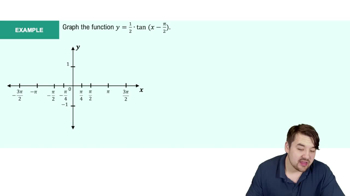
How is the tangent function defined in terms of sine and cosine, and where are its asymptotes?
Tangent is defined as sine divided by cosine, and its asymptotes occur where cosine equals zero (odd multiples of π/2).
What is the period of the tangent function, and how does it differ from sine and cosine?
The period of tangent is π, which is half the period of sine and cosine (2π).
How do you find the period of y = tan(bx)?
The period is π divided by b for y = tan(bx).
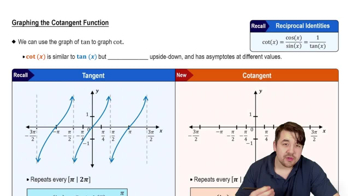
What is the reciprocal of the tangent function, and what is a key feature of its graph?
The reciprocal of tangent is cotangent (cot), and its graph has vertical asymptotes where tangent equals zero (integer multiples of π).
How does the orientation of the cotangent graph differ from the tangent graph?
The cotangent graph decreases from left to right between asymptotes, while the tangent graph increases.
Where are the asymptotes of the cotangent function located?
Cotangent's asymptotes are at integer multiples of π (e.g., ..., -2π, -π, 0, π, 2π, ...).
What is the period of the cotangent function, and how is it calculated for y = cot(bx)?
The period of cotangent is π, and for y = cot(bx), it is π divided by b.
 BackBack

 5:53
5:53