Skip to main content
Calculus
My Course
Learn
Exam Prep
AI Tutor
Study Guides
Textbook Solutions
Flashcards
Explore
Try the app
My Course
Learn
Exam Prep
AI Tutor
Study Guides
Textbook Solutions
Flashcards
Explore
Try the app
Back
Improper Integrals definitions
You can tap to flip the card.
Improper Integral
You can tap to flip the card.
👆
Improper Integral
A definite integral with at least one infinite bound, requiring limits to evaluate.
Track progress
Control buttons has been changed to "navigation" mode.
1/15
Related flashcards
Related practice
Recommended videos
Improper Integrals quiz #1
Improper Integrals
10 Terms
Improper Integrals
12. Techniques of Integration
5 problems
Topic
Ernest
Partial Fractions
12. Techniques of Integration
5 problems
Topic
Jonathan
12. Techniques of Integration
3 topics
9 problems
Chapter
Ernest
Guided course
04:06
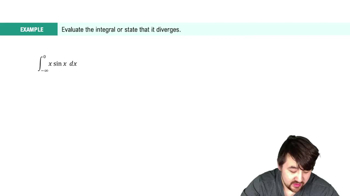
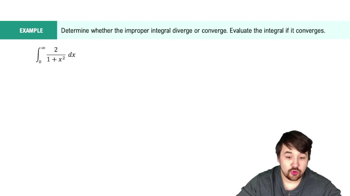
Improper Integrals: Infinite Intervals Example 2
427
views
14
rank
Guided course
05:43
Improper Integrals: Infinite Intervals Example 1
509
views
16
rank
Guided course
11:11
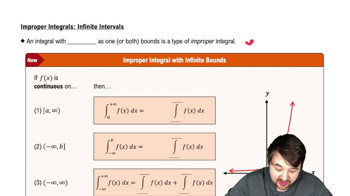
Improper Integrals: Infinite Intervals
757
views
28
rank
Terms in this set (15)
Hide definitions
Improper Integral
A definite integral with at least one infinite bound, requiring limits to evaluate.
Infinite Bound
A situation where the lower or upper limit of integration extends to positive or negative infinity.
Limit
A mathematical process used to define values as a variable approaches infinity or negative infinity.
Convergence
A condition where the evaluated limit of an improper integral results in a finite value.
Divergence
A condition where the evaluated limit of an improper integral does not result in a finite value.
Upper Bound
The highest value in the interval of integration, which can be infinity in improper integrals.
Lower Bound
The lowest value in the interval of integration, which can be negative infinity in improper integrals.
Continuous Function
A function with no breaks or jumps, allowing integration over infinite intervals.
Area Under the Curve
The region between a function and the x-axis, extended to infinity in improper integrals.
Definite Integral
An integral evaluated between two specific bounds, possibly infinite in improper cases.
Variable Substitution
The process of replacing infinity with a variable, then applying a limit as the variable approaches infinity.
Finite Number
A real, non-infinite value resulting from a convergent improper integral.
Splitting Integrals
Dividing an integral with both bounds infinite into two parts at a constant for evaluation.
Exponent
A mathematical expression indicating repeated multiplication, crucial in evaluating functions like e^x at infinity.
Constant
A fixed value used to separate or define intervals when splitting improper integrals.
 BackBack
 04:06
04:06