Back

Integrals Involving Inverse Trigonometric Functions definitions

Control buttons has been changed to "navigation" mode.
1/15
  • Inverse Sine

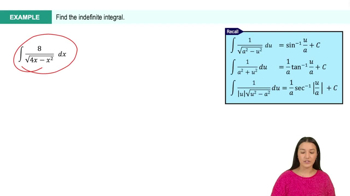
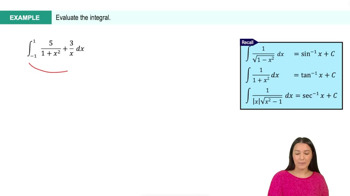
    Function whose derivative yields one over the square root of one minus a variable squared, commonly appears in integrals with this form.
  • Inverse Tangent

    Function whose derivative gives one over one plus a variable squared, used in integrals with quadratic denominators.
  • Inverse Secant

    Function associated with integrals involving one over the absolute value of a variable times the square root of the variable squared minus a constant squared.
  • Constant Multiple Rule

    Technique allowing constants to be factored out of integrals, simplifying evaluation by focusing on the variable part.
  • Substitution

    Method for transforming integrals by replacing a variable with a function, often used to match standard integral forms.
  • Quadratic Denominator

    Expression in the denominator involving a squared variable, often requiring rewriting to fit inverse trigonometric integral forms.
  • Completing the Square

    Process of rewriting a quadratic expression as a perfect square plus or minus a constant, enabling use of inverse trig integrals.
  • Indefinite Integral

    Integral without specified bounds, resulting in a general antiderivative plus a constant of integration.
  • Constant of Integration

    Arbitrary constant added to indefinite integrals, representing all possible antiderivatives.
  • Recognizable Form

    Standardized structure of an integrand that matches known integral formulas, especially those leading to inverse trig functions.
  • Absolute Value

    Notation indicating the non-negative value of a variable, often required in integrals involving inverse secant.
  • Perfect Square Trinomial

    Quadratic expression that can be factored into the square of a binomial, useful for completing the square.
  • Power Rule

    Rule for integrating or differentiating expressions with variables raised to a power, sometimes insufficient for certain integrals.
  • U-Substitution

    Specific substitution where a new variable replaces a function of the original variable, simplifying integration.
  • Antiderivative

    Function whose derivative yields the original integrand, found through integration.