Skip to main content
Calculus
My Course
Learn
Exam Prep
AI Tutor
Study Guides
Textbook Solutions
Flashcards
Explore
Try the app
My Course
Learn
Exam Prep
AI Tutor
Study Guides
Textbook Solutions
Flashcards
Explore
Try the app
Back
Integrals of Trig Functions definitions
You can tap to flip the card.
Integral
You can tap to flip the card.
👆
Integral
A mathematical operation that reverses differentiation, often used to find areas under curves or antiderivatives.
Track progress
Control buttons has been changed to "navigation" mode.
1/15
Related flashcards
Related practice
Recommended videos
Integrals of Trig Functions quiz
Integrals of Trig Functions
15 Terms
Integrals of Trig Functions
7. Antiderivatives & Indefinite Integrals
5 problems
Topic
Ernest
Initial Value Problems
7. Antiderivatives & Indefinite Integrals
5 problems
Topic
Ernest
7. Antiderivatives & Indefinite Integrals
4 topics
11 problems
Chapter
Ernest
Guided course
05:28
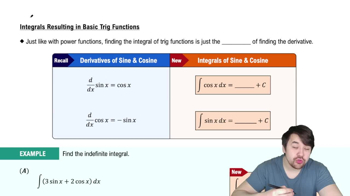
Integrals Resulting in Basic Trig Functions
1538
views
49
rank
2
comments
Guided course
04:22
Integrals Resulting in Basic Trig Functions Example 1
848
views
52
rank
Terms in this set (15)
Hide definitions
Integral
A mathematical operation that reverses differentiation, often used to find areas under curves or antiderivatives.
Trigonometric Function
A function involving angles, such as sine, cosine, tangent, secant, cosecant, and cotangent.
Power Rule
A method for integrating or differentiating expressions where variables are raised to a constant exponent.
Sum and Difference Rule
A property allowing the integration of a sum or difference of functions by integrating each term separately.
Constant Multiple Rule
A property that allows constants to be factored out of integrals for easier computation.
Derivative
A measure of how a function changes as its input changes, foundational for finding integrals by reversal.
Antiderivative
A function whose derivative is the original function, found through integration.
Secant
A trigonometric function equal to the reciprocal of cosine, often appearing in integrals with tangent.
Cosecant
A trigonometric function equal to the reciprocal of sine, commonly paired with cotangent in integrals.
Cotangent
A trigonometric function equal to the reciprocal of tangent, often found in integrals with cosecant squared.
Constant of Integration
An arbitrary constant added to indefinite integrals, representing all possible antiderivatives.
Sine
A fundamental trigonometric function, whose integral yields negative cosine plus a constant.
Cosine
A fundamental trigonometric function, whose integral yields sine plus a constant.
Tangent
A trigonometric function equal to sine divided by cosine, with an integral related to secant squared.
Reverse Derivative Logic
A strategy for integration by recalling which function's derivative produces the given trigonometric expression.
 BackBack
 05:28
05:28