Skip to main content
Calculus
My Course
Learn
Exam Prep
AI Tutor
Study Guides
Textbook Solutions
Flashcards
Explore
Try the app
My Course
Learn
Exam Prep
AI Tutor
Study Guides
Textbook Solutions
Flashcards
Explore
Try the app
Back
Inverse Trigonometric Functions quiz
You can tap to flip the card.
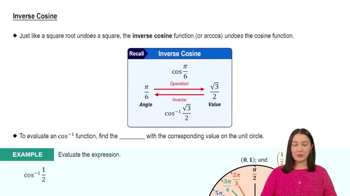
What interval are the angles returned by the inverse cosine function restricted to?
You can tap to flip the card.
👆
What interval are the angles returned by the inverse cosine function restricted to?
The angles returned by the inverse cosine function are restricted to the interval [0, π].
Track progress
Control buttons has been changed to "navigation" mode.
1/15
Related flashcards
Related practice
Recommended videos
Inverse Trigonometric Functions definitions
Inverse Trigonometric Functions
15 Terms
Inverse Trigonometric Functions
0. Functions
3 problems
Topic
Jonathan
Trigonometric Identities
0. Functions
2 problems
Topic
0. Functions - Part 1 of 2
7 topics
14 problems
Chapter
Patrick
0. Functions - Part 2 of 2
8 topics
12 problems
Chapter
David-Paige
1:58
Example 1
657
views
4
rank
3:17
Inverse Tangent
850
views
5
rank
4:49
Inverse Cosine
1324
views
14
rank
Terms in this set (15)
Hide definitions
What interval are the angles returned by the inverse cosine function restricted to?
The angles returned by the inverse cosine function are restricted to the interval [0, π].
What values can be input into the inverse sine function?
The input values for the inverse sine function must be between -1 and 1.
What is the output interval for the inverse sine function?
The output angles for the inverse sine function are between -π/2 and π/2.
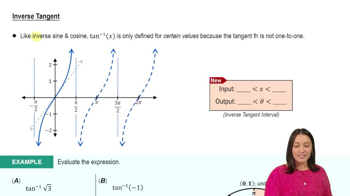
What is the output interval for the inverse tangent function?
The output angles for the inverse tangent function are between -π/2 and π/2.
What is the inverse cosine of 1/2?
The inverse cosine of 1/2 is π/3, since π/3 is within the interval [0, π].
What is the inverse sine of 1/2?
The inverse sine of 1/2 is π/6, since π/6 is within the interval [-π/2, π/2].
What is the inverse sine of -√2/2?
The inverse sine of -√2/2 is -π/4, since -π/4 is within the interval [-π/2, π/2].
What is the inverse tangent of √3?
The inverse tangent of √3 is π/3, since π/3 is within the interval [-π/2, π/2].
What is the inverse tangent of -1?
The inverse tangent of -1 is -π/4, since -π/4 is within the interval [-π/2, π/2].
How do you evaluate composite functions like sin(cos⁻¹(1/2))?
Evaluate the inner function first (cos⁻¹(1/2) = π/3), then apply the outer function (sin(π/3) = √3/2).
What is the cosine of the inverse tangent of 0?
The cosine of the inverse tangent of 0 is 1, since tan⁻¹(0) = 0 and cos(0) = 1.
What is the inverse cosine of the sine of π/3?
The sine of π/3 is √3/2, and the inverse cosine of √3/2 is π/6.
Why can't you simply cancel inverse trig functions with their corresponding trig functions in composite expressions?
You must consider the interval for which the inverse function is defined; simply canceling may give an incorrect answer.
What is the inverse cosine of the cosine of 11π/6?
The cosine of 11π/6 is √3/2, and the inverse cosine of √3/2 is π/6, not 11π/6.
What happens if you try to evaluate the inverse sine of 2?
The inverse sine of 2 is undefined because 2 is outside the interval [-1, 1] for valid input values.
 BackBack


 1:58
1:58