Skip to main content
Calculus
My Course
Learn
Exam Prep
AI Tutor
Study Guides
Textbook Solutions
Flashcards
Explore
Try the app
My Course
Learn
Exam Prep
AI Tutor
Study Guides
Textbook Solutions
Flashcards
Explore
Try the app
Back
Trigonometric Identities quiz
You can tap to flip the card.
What are the three criteria for a fully simplified trigonometric expression?
You can tap to flip the card.
👆
What are the three criteria for a fully simplified trigonometric expression?
All arguments must be positive, the expression should contain no fractions, and it should have as few trig functions as possible.
Track progress
Control buttons has been changed to "navigation" mode.
1/15
Related flashcards
Related practice
Recommended videos
Trigonometric Identities definitions
Trigonometric Identities
15 Terms
Trigonometric Identities
0. Functions
2 problems
Topic
Inverse Trigonometric Functions
0. Functions
3 problems
Topic
Jonathan
0. Functions - Part 1 of 2
7 topics
14 problems
Chapter
Patrick
0. Functions - Part 2 of 2
8 topics
12 problems
Chapter
David-Paige
7:17
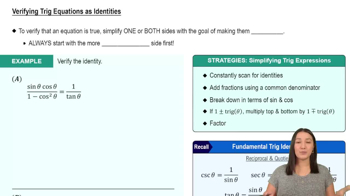
Verifying Trig Equations as Identities
931
views
8
rank
6:36
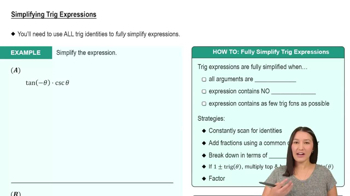
Simplifying Trig Expressions
1570
views
12
rank
5:18
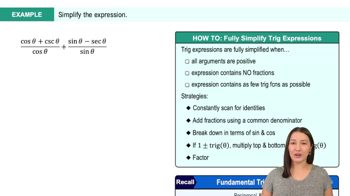
Simplifying Trig Expressions Example 2
995
views
9
rank
1
comments
Terms in this set (15)
Hide definitions
What are the three criteria for a fully simplified trigonometric expression?
All arguments must be positive, the expression should contain no fractions, and it should have as few trig functions as possible.
Which identity allows you to rewrite tan(-θ) as a function of tan(θ)?
The even-odd identity states that tan(-θ) = -tan(θ).
How do you convert tangent and cosecant to sine and cosine?
Tangent is sine over cosine (tan(θ) = sin(θ)/cos(θ)), and cosecant is 1 over sine (csc(θ) = 1/sin(θ)).
What is the simplified form of tan(-θ) * csc(θ)?
It simplifies to -sec(θ) by applying identities and reducing to a single trig function.
What strategy should you use when you see 1 plus or minus a trig function in a fraction's denominator?
Multiply both the numerator and denominator by 1 minus or plus that same trig function to use the difference of squares.
How does sin²(θ) / (1 + cos(θ)) simplify?
It simplifies to 1 - cos(θ) by multiplying by (1 - cos(θ)) and using the Pythagorean identity.
What is the Pythagorean identity involving sine and cosine?
sin²(θ) + cos²(θ) = 1.
What is the process for verifying a trigonometric identity?
Simplify one or both sides of the equation using identities until both sides are equal.
How do you simplify sin(θ) * cos(θ) / (1 - cos²(θ))?
Replace 1 - cos²(θ) with sin²(θ), then simplify to cot(θ) or 1/tan(θ).
What identity relates sec²(θ) and tan²(θ)?
tan²(θ) + 1 = sec²(θ), so sec²(θ) - tan²(θ) = 1.
How do you handle cosine of a negative angle, cos(-θ)?
Cosine is an even function, so cos(-θ) = cos(θ).
What is the result of simplifying sec²(θ) - tan²(θ) / (cos(-θ) + 1)?
It simplifies to 1 / (cos(θ) + 1) by using identities and even-odd properties.
What should you do if you get stuck while simplifying or verifying a trig identity?
Start over from scratch, as a new approach may reveal a solution.
How do you solve sec²(θ) - 1 / tan(θ) = 1?
Rewrite sec²(θ) - 1 as tan²(θ), simplify to tan(θ) = 1, and solve for θ using the unit circle.
How do you use the double angle identity to simplify sin(2θ) / cos(-θ) = 1?
Rewrite sin(2θ) as 2sin(θ)cos(θ), use cos(-θ) = cos(θ), cancel cos(θ), and solve 2sin(θ) = 1 for θ.
 BackBack

 7:17
7:17