Skip to main content
Calculus
My Course
Learn
Exam Prep
AI Tutor
Study Guides
Textbook Solutions
Flashcards
Explore
Try the app
My Course
Learn
Exam Prep
AI Tutor
Study Guides
Textbook Solutions
Flashcards
Explore
Try the app
Back
Work definitions
You can tap to flip the card.
Work
You can tap to flip the card.
👆
Work
The total energy transferred to move an object by a force over a distance, represented as the area under a force versus distance curve.
Track progress
Control buttons has been changed to "navigation" mode.
1/15
Related flashcards
Related practice
Recommended videos
Work quiz
Work
15 Terms
Work
10. Physics Applications of Integrals
5 problems
Topic
Ernest
Kinematics
10. Physics Applications of Integrals
5 problems
Topic
Jonathan
10. Physics Applications of Integrals
2 topics
6 problems
Chapter
Ernest
06:02
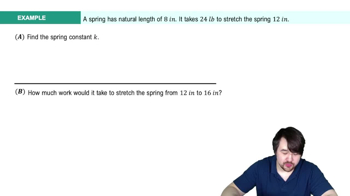
Work Done On A Spring (Hooke's Law) Example 1
266
views
6
rank
Guided course
11:50
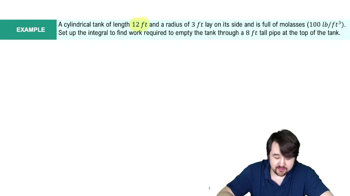
Pumping Liquids Example 5
205
views
3
rank
Guided course
06:22
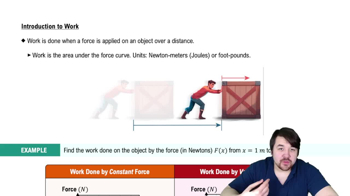
Introduction To Work
551
views
10
rank
Terms in this set (15)
Hide definitions
Work
The total energy transferred to move an object by a force over a distance, represented as the area under a force versus distance curve.
Force
A push or pull acting on an object, often measured in newtons or pounds, which may vary with position in calculus problems.
Joule
A unit of measurement for energy or work, equivalent to applying one newton of force over one meter.
Foot-pound
A unit of work or energy, representing the effort of applying one pound of force over one foot.
Integral
A mathematical tool used to sum continuously varying quantities, such as calculating total work from a variable force.
Spring Constant
A measure of a spring's stiffness, denoted by k, indicating the force needed to stretch or compress the spring by a unit length.
Hooke's Law
A principle stating that the force needed to stretch or compress a spring is proportional to the displacement from equilibrium.
Equilibrium Point
The natural resting position of a spring where no external force is applied and the spring is neither stretched nor compressed.
Weight Density
The weight per unit length or volume, used to convert mass-based measurements into force for work calculations.
Cross-sectional Area
The surface area of a slice perpendicular to the direction of motion, crucial for determining the volume or weight of material moved.
Antiderivative
A function whose derivative yields the original function, used to compute definite integrals in work problems.
Bounds
The starting and ending values for integration, representing the interval over which work is calculated.
Variable Force
A force that changes in magnitude over distance, requiring integration to determine total work.
Constant Force
A force that remains unchanged over the distance moved, allowing work to be calculated as force times distance.
Distance Function
An expression representing how far each part of an object or fluid must be moved, often varying with position in work problems.
 BackBack
 06:02
06:02