 Back
Implicit Differentiation and Applications in Calculus
Study Guide - Smart Notes
 Tailored notes based on your materials, expanded with key definitions, examples, and context.
Implicit Differentiation
Introduction to Implicit Functions
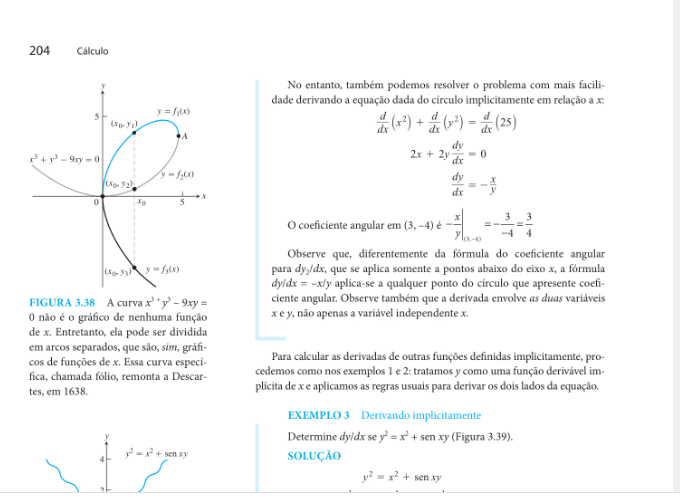
In calculus, not all curves can be represented as explicit functions of the form y = f(x). Some curves are defined implicitly by equations involving both x and y. An example is the curve defined by x3 + y3 - 9xy = 0, which is not the graph of any single function of x, but can be divided into arcs that are graphs of functions of x. This specific curve, known as the folium of Descartes, dates back to 1638.
Implicit Differentiation of the Circle
Implicit differentiation is a technique used to find derivatives when y is defined implicitly as a function of x. For example, consider the equation of a circle:
Equation:
To differentiate both sides with respect to x:
Apply the derivative operator to both sides:
Differentiate each term:
Solve for :
This formula applies to any point on the circle, regardless of its position relative to the axes.
Geometric Interpretation: Slope of the Tangent
The slope of the tangent line at a point (x0, y0) on the circle is given by:
For example, at the point (3, -4):
Unlike the formula for , which applies only to points below the x-axis, the formula applies to any point on the circle.
General Approach to Implicit Differentiation
To calculate derivatives of other functions defined implicitly, treat y as a differentiable function of x and apply the usual rules for differentiation to both sides of the equation.
Differentiate each term with respect to x, using the chain rule where necessary.
Solve for to obtain the derivative.
Example: Implicit Differentiation
Example 3: Deriving for
Given the equation , find .
Step 1: Differentiate both sides with respect to x:
Step 2: Apply the chain rule:
Step 3: Differentiate using the product rule:
Step 4: Substitute and solve for :
Collect terms with :
Summary Table: Steps in Implicit Differentiation
Step | Description |
|---|---|
1 | Differentiate both sides of the equation with respect to x |
2 | Apply chain rule and product rule as needed |
3 | Collect terms involving |
4 | Solve for |
Additional info: The folium of Descartes is a classic example of a curve defined implicitly, and implicit differentiation is a fundamental technique for finding slopes and rates of change for such curves.
