 Back
BackInfinite Limits and Their Properties
Study Guide - Smart Notes
 Tailored notes based on your materials, expanded with key definitions, examples, and context.
Limits and Continuity
Infinite Limits
In calculus, infinite limits describe the behavior of a function as it increases or decreases without bound near a certain point. This concept is essential for understanding vertical asymptotes and the unbounded growth of functions.
Definition: Let f be a function defined on both sides of a, except possibly at a itself. We write to indicate that the values of f(x) can be made arbitrarily large (positive) by taking x sufficiently close to a (but not equal to a).
Similarly, means f(x) can be made arbitrarily large in the negative direction.
This does not mean the limit exists in the traditional sense, but rather describes the function's unbounded behavior near a.
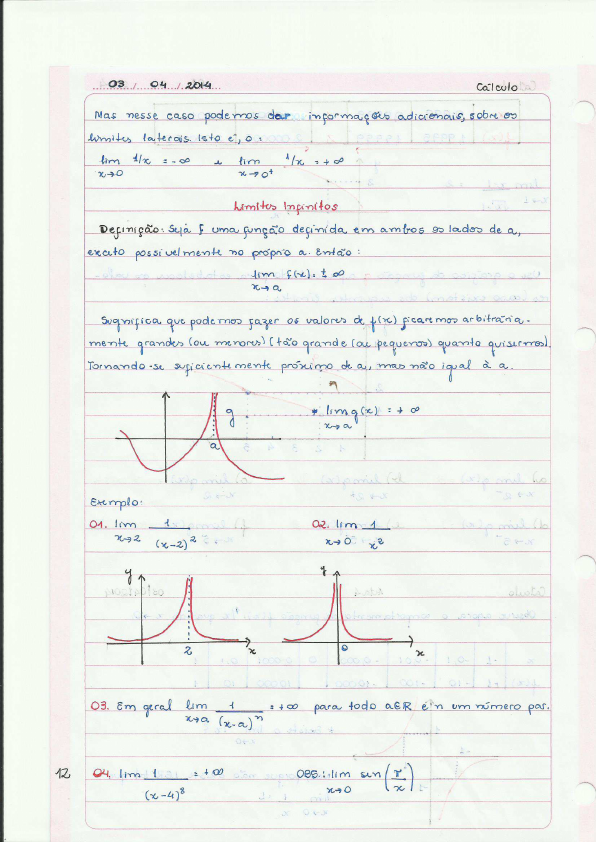
Examples of Infinite Limits
Example 1: This function grows without bound as x approaches 2 from either side, indicating a vertical asymptote at x = 2.
Example 2: As x approaches 0, the function increases without bound, showing a vertical asymptote at x = 0.
General Case: for all even integers n.
Example 3: This is another case of a vertical asymptote at x = 4.
Key Properties and Observations
Infinite limits often indicate the presence of a vertical asymptote in the graph of the function.
They are used to describe the unbounded behavior of rational functions and other expressions where the denominator approaches zero.
One-sided infinite limits can also be considered, such as: and
Special Limits
Trigonometric Example: This is a fundamental limit in calculus, often used in the study of derivatives of trigonometric functions.
