 Back
BackLimits and Infinite Limits: Study Notes
Study Guide - Smart Notes
 Tailored notes based on your materials, expanded with key definitions, examples, and context.
Limits and Continuity
Infinite Limits
Infinite limits occur when the value of a function increases or decreases without bound as the input approaches a certain point. This concept is fundamental in calculus, especially when analyzing functions near points of discontinuity or singularity.
Definition: Let f be a function defined on both sides of a, except possibly at a itself. We say that the limit of f(x) as x approaches a is infinite if:
This means that the values of f(x) can be made arbitrarily large (or small) as x gets sufficiently close to a, but not equal to a.
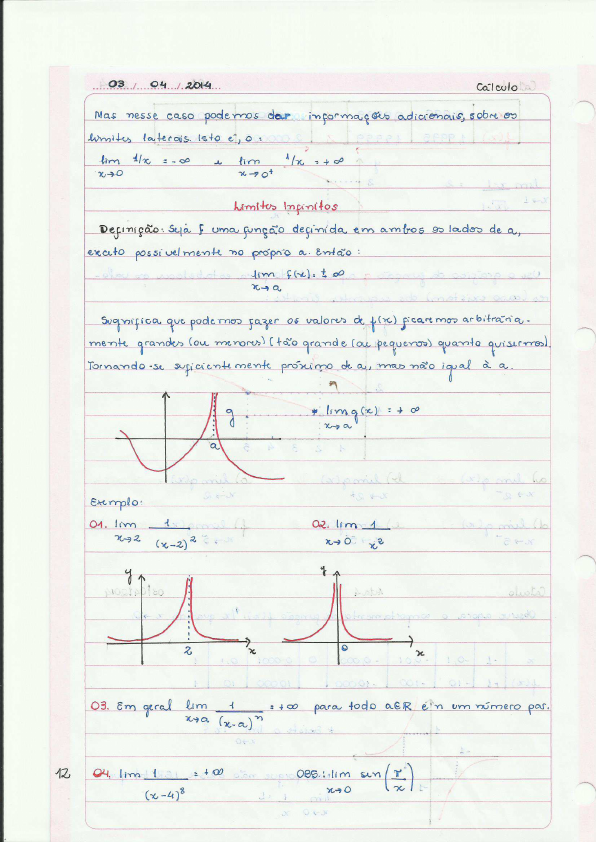
Key Point: Infinite limits describe the behavior of functions near points where they diverge to positive or negative infinity.
Example: The function as diverges to infinity or negative infinity depending on the direction of approach.
Examples of Infinite Limits
Several classic examples illustrate infinite limits:
Example 1:
Example 2:
General Rule: for all n in the set of positive integers.
Example 3:
Example 4: (This is a classic limit, not infinite, but often discussed in the context of limits approaching zero.)
Additional info: The notes also mention lateral limits (left and right limits), which are important when the function behaves differently from each side of the point.
Lateral Limits: and
Understanding infinite limits is crucial for analyzing asymptotic behavior and discontinuities in functions.
