 Back
BackLimits: Infinite Limits and Lateral Limits
Study Guide - Smart Notes
 Tailored notes based on your materials, expanded with key definitions, examples, and context.
Limits and Continuity
Infinite Limits
Infinite limits describe the behavior of a function as it approaches a certain point, where the function's value increases or decreases without bound. This concept is fundamental in calculus for understanding discontinuities and asymptotic behavior.
Definition: Let f be a function defined on both sides of a, except possibly at a itself. We say that the limit of f(x) as x approaches a is infinite if:
This means we can make the values of f(x) arbitrarily large (or small) by taking x sufficiently close to a, but not equal to a.
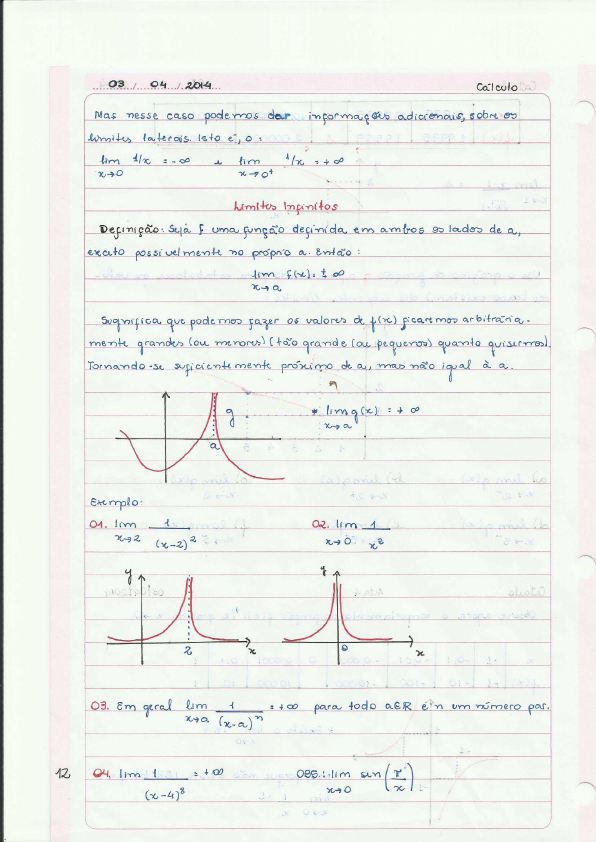
Example: The function as approaches infinity.
Example: The function as approaches infinity.
General Rule: For any real number a,
for even
Example:
Example: (not infinite, but a classic limit)
Lateral Limits
Lateral limits (or one-sided limits) provide additional information about the behavior of a function as it approaches a point from one side only. This is important for analyzing discontinuities and asymptotes.
Left-hand limit:
Right-hand limit:
Key Points:
Infinite limits indicate vertical asymptotes in the graph of a function.
Lateral limits help distinguish between different behaviors on either side of a point.
Additional info: The notes also briefly mention the classic limit , which is a fundamental result in calculus, though not an infinite limit.
