Skip to main content
Cell Biology
My Course
Learn
Exam Prep
AI Tutor
Study Guides
Flashcards
Explore
Try the app
My Course
Learn
Exam Prep
AI Tutor
Study Guides
Flashcards
Explore
Try the app
Back
Antibody Structure and Diversity definitions
You can tap to flip the card.
Antibody
You can tap to flip the card.
👆
Antibody
Y-shaped protein produced by B cells, composed of two heavy and two light chains, with highly specific antigen recognition.
Track progress
Control buttons has been changed to "navigation" mode.
1/16
Related flashcards
Related practice
Recommended videos
Antibody Structure and Diversity quiz
Antibody Structure and Diversity
15 Terms
Antibody Structure and Diversity
21. The Immune System
7 problems
Topic
T Cells
21. The Immune System
7 problems
Topic
21. The Immune System - Part 1 of 2
4 topics
11 problems
Chapter
21. The Immune System - Part 2 of 2
4 topics
10 problems
Chapter
Guided course
06:12
Antibody Variation
240
views
6
rank
Guided course
06:11
Antibody Structure
324
views
5
rank
Terms in this set (16)
Hide definitions
Antibody
Y-shaped protein produced by B cells, composed of two heavy and two light chains, with highly specific antigen recognition.
Immunoglobulin
Alternate name for antibody, often abbreviated as Ig, referring to the same Y-shaped immune protein.
Heavy Chain
Larger polypeptide component of an antibody, present in two copies, determining antibody class and function.
Light Chain
Smaller polypeptide component of an antibody, present in two copies, contributing to antigen binding.
Antigen-Binding Site
Region at the tips of the antibody Y structure, formed by both heavy and light chains, responsible for antigen recognition.
Variable Region
Portion of antibody chains with sequence diversity, enabling recognition of a vast array of antigens.
Constant Region
Segment of antibody chains with conserved sequence within each class, determining effector function.
Hypervariable Region
Short stretch within the variable region, containing the most sequence diversity and direct antigen contact points.
VDJ Recombination
Genetic mechanism shuffling variable, diversity, and joining gene segments to generate antibody diversity.
Somatic Hypermutation
Process introducing frequent mutations in antibody variable regions of B cells, enhancing antigen affinity.
Class Switching
Cellular process enabling B cells to change the antibody class produced, adapting immune responses.
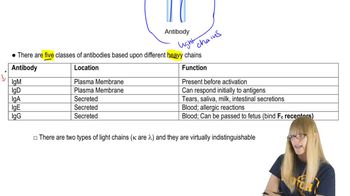
IgM
Primary antibody class found on B cell membranes, first produced during immune response.
IgD
Antibody class present on B cell membranes, involved in early immune response stages.
IgA
Antibody class secreted in mucosal areas, such as tears and saliva, providing localized protection.
IgE
Antibody class associated with allergic reactions and defense against parasites.
IgG
Most abundant antibody class in blood, capable of crossing the placenta to protect the fetus.
 BackBack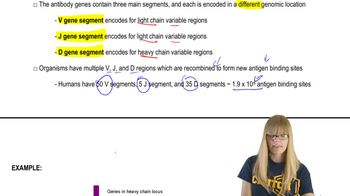
 06:12
06:12