Skip to main content
Cell Biology
My Course
Learn
Exam Prep
AI Tutor
Study Guides
Flashcards
Explore
Try the app
My Course
Learn
Exam Prep
AI Tutor
Study Guides
Flashcards
Explore
Try the app
Back
Basics of Gene Expression Control definitions
You can tap to flip the card.
Gene Expression
You can tap to flip the card.
👆
Gene Expression
Selective process by which cells produce specific proteins and RNAs, enabling unique cell functions despite identical genetic material.
Track progress
Control buttons has been changed to "navigation" mode.
1/15
Related flashcards
Related practice
Recommended videos
Basics of Gene Expression Control quiz #1
Basics of Gene Expression Control
10 Terms
Basics of Gene Expression Control
7. Gene Expression
7 problems
Topic
Epigenetic Regulation of Gene Expression
7. Gene Expression
7 problems
Topic
7. Gene Expression
5 topics
15 problems
Chapter
Guided course
11:23
Gene Expression Control Basics
794
views
1
rank
1
comments
Terms in this set (15)
Hide definitions
Gene Expression
Selective process by which cells produce specific proteins and RNAs, enabling unique cell functions despite identical genetic material.
Cell Differentiation
Process resulting in specialized cell types, driven by selective activation of certain genes for distinct cellular roles.
Housekeeping Genes
Genetic elements required for basic cellular survival, consistently active in all cell types regardless of function.
Transcriptional Control
Regulation determining whether a gene's DNA is converted into RNA, often influenced by DNA accessibility and chemical modifications.
Histone Modification
Chemical changes to proteins around which DNA is wrapped, affecting gene accessibility and transcription potential.
DNA Methylation
Addition of chemical groups to DNA, typically silencing genes by blocking access to transcription machinery.
Multipotent Stem Cell
Progenitor capable of generating multiple specialized cell types, such as various blood cells, through gene expression changes.
RNA Splicing
Editing process where specific RNA segments are joined or removed, creating diverse mRNA and protein variants from a single gene.
RNA Transport
Movement of RNA molecules to specific cellular locations, influencing where and how gene products are synthesized.
Translational Control
Mechanism regulating whether mRNA is used to build proteins, impacting the final output of gene expression.
Exon
Segment of a gene's RNA that is retained and joined during splicing, contributing to the final mRNA and protein structure.
Transcription Machinery
Collection of proteins and enzymes responsible for reading DNA and synthesizing RNA during gene expression.
External Signals
Environmental or hormonal cues that influence gene activity, enabling cells to adapt gene expression to changing conditions.
Gene Product
Functional molecule, such as a protein or RNA, resulting from the expression of a gene and determining cellular traits.
Cell Specialization
Outcome of selective gene expression, resulting in cells with unique structures and functions within an organism.
 BackBack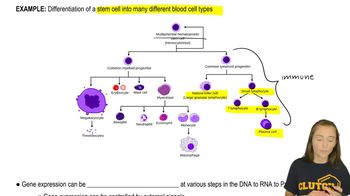
 11:23
11:23