Skip to main content
Cell Biology
My Course
Learn
Exam Prep
AI Tutor
Study Guides
Flashcards
Explore
Try the app
My Course
Learn
Exam Prep
AI Tutor
Study Guides
Flashcards
Explore
Try the app
Back
DNA Discovery definitions
You can tap to flip the card.
Genetic Material
You can tap to flip the card.
👆
Genetic Material
Molecule responsible for storing and transmitting hereditary information in living organisms.
Track progress
Control buttons has been changed to "navigation" mode.
1/15
Related flashcards
Related practice
Recommended videos
DNA Discovery quiz #1
DNA Discovery
10 Terms
DNA Discovery
4. DNA, Chromosomes, and Genomes
7 problems
Topic
Structure and Function of DNA
4. DNA, Chromosomes, and Genomes
7 problems
Topic
4. DNA, Chromosomes, and Genomes - Part 1 of 2
5 topics
14 problems
Chapter
4. DNA, Chromosomes, and Genomes - Part 2 of 2
5 topics
13 problems
Chapter
Guided course
05:38
Important Scientists
685
views
8
rank
1
comments
Terms in this set (15)
Hide definitions
Genetic Material
Molecule responsible for storing and transmitting hereditary information in living organisms.
Protein
Complex macromolecule once believed to store genetic information due to its diversity of amino acids.
Amino Acid
Building block of proteins, with twenty varieties contributing to protein complexity.
DNA
Nucleic acid identified as the true carrier of genetic information in cells and viruses.
DNA Base
One of four chemical units forming the genetic code within the DNA molecule.
Oswald Avery
Scientist whose experiments with bacteria demonstrated that nucleic acids, not proteins, carry genetic traits.
Hershey-Chase Experiment
Study using radioactive labeling to confirm that viruses transfer nucleic acids, not proteins, to infect bacteria.
Bacteriophage
Virus that specifically infects bacterial cells, used in pivotal genetic experiments.
Double Helix
Spiral structure explaining how genetic information is stored, replicated, and inherited in DNA.
James Watson
Researcher who, with Francis Crick, elucidated the three-dimensional structure of DNA.
Francis Crick
Scientist who co-discovered the structural model of DNA, revealing its role in heredity.
Nucleic Acid
Type of biological macromolecule, including DNA, essential for genetic information storage.
Radioactive Labeling
Technique for tracking molecules by attaching detectable isotopes, crucial in identifying genetic material.
Infectivity
Ability of an agent, such as a virus or bacterium, to cause infection in a host organism.
Replication
Process by which genetic information is precisely copied for inheritance during cell division.
 BackBack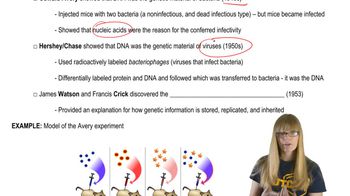
 05:38
05:38