Skip to main content
Cell Biology
My Course
Learn
Exam Prep
AI Tutor
Study Guides
Flashcards
Explore
Try the app
My Course
Learn
Exam Prep
AI Tutor
Study Guides
Flashcards
Explore
Try the app
Back
Evolution of the Genome definitions
You can tap to flip the card.
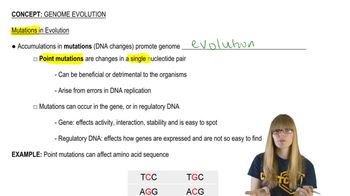
Point Mutation
You can tap to flip the card.
👆
Point Mutation
A single nucleotide pair change that can alter protein structure and function, sometimes with significant effects on the organism.
Track progress
Control buttons has been changed to "navigation" mode.
1/16
Related flashcards
Related practice
Recommended videos
Evolution of the Genome quiz
Evolution of the Genome
15 Terms
Evolution of the Genome
4. DNA, Chromosomes, and Genomes
7 problems
Topic
Genomic Comparison
4. DNA, Chromosomes, and Genomes
7 problems
Topic
4. DNA, Chromosomes, and Genomes - Part 1 of 2
5 topics
14 problems
Chapter
4. DNA, Chromosomes, and Genomes - Part 2 of 2
5 topics
13 problems
Chapter
Guided course
06:57
Gene Duplication
467
views
1
rank
1
comments
Guided course
03:08
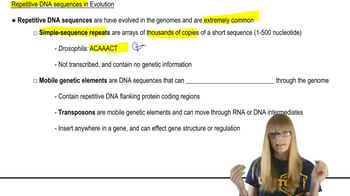
Repetitive DNA Sequences
456
views
1
rank
Guided course
03:09
Mutations
370
views
Terms in this set (16)
Hide definitions
Point Mutation
A single nucleotide pair change that can alter protein structure and function, sometimes with significant effects on the organism.
Regulatory DNA Sequence
A non-coding region controlling gene expression, where changes can subtly or drastically impact gene activity and organism traits.
Gene Duplication
A process creating extra gene copies, often through improper chromosome alignment, fueling genetic diversity and new functions.
Gene Family
A group of related genes with similar sequences but specialized roles, often originating from duplication events.
Pseudogene
A nonfunctional gene copy, often arising from duplication and mutation, that remains in the genome but is not expressed.
Processed Pseudogene
A nonfunctional gene copy created when RNA is reverse-transcribed and inserted into the genome, usually in a silent region.
Whole Genome Duplication
An event where an organism's entire genetic material is copied, sometimes resulting in larger or more complex organisms.
Polyploidization
The condition of having multiple complete sets of chromosomes, often due to whole genome duplication, common in plants and some animals.
Intron
A non-coding gene segment removed during RNA processing, present in most but not all eukaryotic genes.
Exon
A coding gene segment retained in mature RNA, whose arrangement can vary to produce different protein forms.
Alternative Splicing
A mechanism generating diverse protein isoforms by combining exons from a single gene in various orders.
Exon Shuffling
A process combining exons from different genes, creating novel proteins and driving gene evolution.
Isoform
A variant of a protein produced from the same gene through alternative splicing, differing in exon composition.
Simple Sequence Repeat
A short DNA motif repeated many times throughout the genome, often with unclear function but influencing genome structure.
Mobile Genetic Element
A DNA sequence capable of moving within the genome, potentially altering gene structure or regulation.
Transposon
A type of mobile genetic element that can relocate as DNA or RNA, impacting gene function and genome evolution.
 BackBack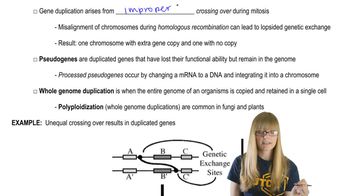
 06:57
06:57