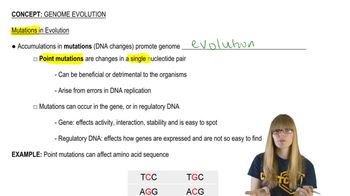
What is a point mutation and how can it affect a protein?
A point mutation is a change in a single nucleotide pair in DNA. It can alter the amino acid sequence of a protein, potentially changing its structure and function.
How do mutations in regulatory DNA sequences influence genome evolution?
Mutations in regulatory DNA can change how genes are expressed, either turning them on or off or altering their expression levels, which can accumulate and drive significant evolutionary changes.
What is gene duplication and why is it important for genome evolution?
Gene duplication is the creation of an extra copy of a gene, often due to improper crossing over during mitosis. It provides raw material for evolution, as duplicated genes can acquire new functions.
What are gene families and how do they arise?
Gene families are groups of genes with similar sequences but specialized functions. They arise from gene duplication followed by divergence through mutation.
How did the hemoglobin subunits in humans evolve?
The hemoglobin subunits evolved from a single ancestral gene that duplicated and diverged, resulting in the current alpha and beta subunits.
What is a pseudogene and how does it form?
A pseudogene is a duplicated gene that has lost its function due to accumulated mutations or relocation to non-transcribed regions. It remains in the genome but is not functional.
What is a processed pseudogene?
A processed pseudogene forms when a gene is transcribed into RNA, then reverse-transcribed back into DNA and inserted into the genome, often in a location where it is not transcribed.
What is whole genome duplication and in which organisms is it common?
Whole genome duplication is the copying of an organism's entire genome, resulting in extra sets of chromosomes. It is common in fungi, plants, and some frog species.
What are introns and exons?
Introns are non-coding regions of a gene that are removed during RNA processing, while exons are coding regions that remain in the mature mRNA.
What is alternative splicing and how does it contribute to protein diversity?
Alternative splicing is the process of combining exons from a single gene in different orders, producing multiple protein isoforms from one gene. This increases protein diversity.
What is exon shuffling and how does it affect gene evolution?
Exon shuffling is the recombination of exons from different genes, creating new genes with novel functions. It is a major mechanism for generating genetic diversity.
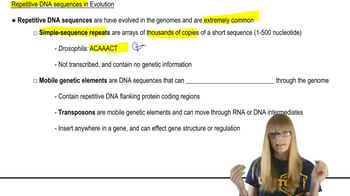
What are simple sequence repeats and where are they found?
Simple sequence repeats are short, repetitive DNA sequences found throughout the genome. They are common in many organisms, including humans and fruit flies.
What are mobile genetic elements and how do they move?
Mobile genetic elements are DNA sequences that can move to different locations within the genome. They can insert themselves into genes or regulatory regions, affecting gene function and evolution.
How can transposons influence genome evolution?
Transposons are mobile genetic elements that can move as RNA or DNA, inserting into genes or regulatory regions. Their movement can disrupt gene function or regulation, driving evolutionary change.
Why are repetitive DNA sequences significant in genome evolution?
Repetitive DNA sequences can influence genome structure and function by taking up space and affecting how the genome is organized and regulated. Their presence can drive evolutionary adaptations.
 Back
Back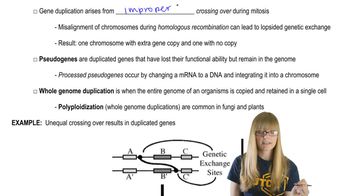
 06:57
06:57