Skip to main content
Cell Biology
My Course
Learn
Exam Prep
AI Tutor
Study Guides
Flashcards
Explore
Try the app
My Course
Learn
Exam Prep
AI Tutor
Study Guides
Flashcards
Explore
Try the app
Back
G1 Phase definitions
You can tap to flip the card.
G1 Phase
You can tap to flip the card.
👆
G1 Phase
Growth period after interphase where the cell increases in size and prepares essential components for division.
Track progress
Control buttons has been changed to "navigation" mode.
1/15
Related flashcards
Related practice
Recommended videos
G1 Phase quiz #1
G1 Phase
22 Terms
G1 Phase
16. Cell Division
7 problems
Topic
DNA Replication
16. Cell Division
7 problems
Topic
16. Cell Division - Part 1 of 2
5 topics
14 problems
Chapter
16. Cell Division - Part 2 of 2
5 topics
13 problems
Chapter
Guided course
06:15
G1 Phase
724
views
5
rank
Guided course
02:18
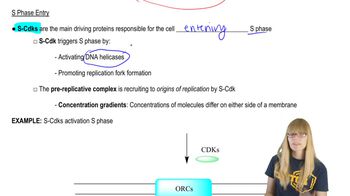
S Phase Entry
385
views
1
rank
Terms in this set (15)
Hide definitions
G1 Phase
Growth period after interphase where the cell increases in size and prepares essential components for division.
Start Checkpoint
Critical control point ensuring the cell is ready to commit to DNA replication and division.
Mitogen
Extracellular signal, such as a hormone or protein, that stimulates cellular growth and cell cycle entry.
Cyclin
Regulatory protein whose levels fluctuate to control progression through specific cell cycle phases.
Cyclin-Dependent Kinase
Enzyme activated by cyclins, driving cell cycle transitions by phosphorylating target proteins.
S Phase
Cell cycle stage where DNA replication occurs, following successful completion of G1.
p53
Transcription regulator that halts cell cycle progression in response to DNA damage, preventing faulty division.
G0 Phase
Non-dividing state entered by cells with damage or insufficient growth, allowing repair or permanent exit from the cycle.
Apoptosis
Programmed cell death mechanism activated when cellular damage is irreparable, ensuring tissue health.
S Cyclin-Dependent Kinase
Protein complex initiating DNA replication by activating replication machinery at the start of S phase.
DNA Helicase
Enzyme that unwinds DNA strands, enabling replication during S phase.
Pre-Replicative Complex
Assembly of proteins at origins of replication, preparing DNA for synthesis in S phase.
Origin of Replication
Specific DNA sequence where replication begins, marked by recruitment of replication proteins.
Transcription Factor
Protein that regulates gene expression, often activated by mitogens during cell cycle progression.
Cell Cycle
Ordered series of events including growth, DNA replication, and division, tightly regulated for cellular health.
 BackBack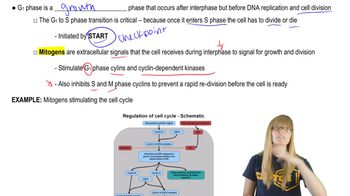
 06:15
06:15