Skip to main content
Cell Biology
My Course
Learn
Exam Prep
AI Tutor
Study Guides
Flashcards
Explore
Try the app
My Course
Learn
Exam Prep
AI Tutor
Study Guides
Flashcards
Explore
Try the app
Back
Human Genetic Variation definitions
You can tap to flip the card.
Human Genome
You can tap to flip the card.
👆
Human Genome
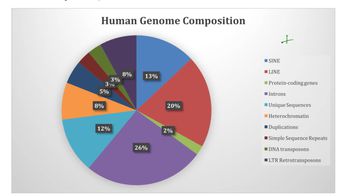
Composed of about 3.2 billion nucleotide pairs organized into 23 chromosomes, with only a small fraction encoding proteins.
Track progress
Control buttons has been changed to "navigation" mode.
1/15
Related flashcards
Related practice
Recommended videos
Human Genetic Variation quiz #1
Human Genetic Variation
10 Terms
Human Genetic Variation
4. DNA, Chromosomes, and Genomes
5 problems
Topic
Transposons and Viruses
4. DNA, Chromosomes, and Genomes
2 problems
Topic
4. DNA, Chromosomes, and Genomes - Part 1 of 2
5 topics
14 problems
Chapter
4. DNA, Chromosomes, and Genomes - Part 2 of 2
5 topics
13 problems
Chapter
Guided course
05:22
Human Evolution
311
views
1
comments
Guided course
08:47
Genetic Variation
297
views
Terms in this set (15)
Hide definitions
Human Genome
Composed of about 3.2 billion nucleotide pairs organized into 23 chromosomes, with only a small fraction encoding proteins.
Protein-Coding Region
Genomic segment responsible for specifying proteins, making up less than 2% of the total human genome.
Mobile Genetic Elements
DNA sequences capable of moving within the genome, contributing to genetic diversity and evolution.
Non-Coding RNA
Functional RNA molecules transcribed from DNA that do not translate into proteins but have regulatory or unknown roles.
Highly Conserved Sequence
Genomic region maintained with little change across different species, indicating essential biological functions.
Chromosome
Structure composed of DNA and proteins, carrying genetic information and organized into 23 pairs in humans.
Gene
Segment of DNA that contains instructions for synthesizing proteins or functional RNA molecules.
Exon
Portion of a gene that remains in the mature RNA after splicing and codes for part of a protein.
Intron
Non-coding segment within a gene that is removed during RNA processing and does not contribute to protein sequence.
Single Nucleotide Polymorphism
Variation at a single DNA base pair among individuals, serving as a common source of genetic diversity.
Copy Number Variation
Difference in the number of copies of a particular gene or DNA segment between individuals.
CA Repeat
Tandemly repeated sequence of cytosine and adenine nucleotides, highly variable and used in DNA fingerprinting.
DNA Fingerprinting
Technique for identifying individuals based on unique patterns of genetic markers, such as CA repeats.
Human Accelerated Region
Genomic segment that evolved rapidly in humans compared to other primates, often linked to brain development.
Genetic Variation
Differences in DNA sequences among individuals, underlying traits like hair color, height, and susceptibility to disease.
 BackBack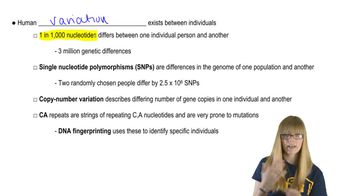
 05:22
05:22